AI is transforming customer support by helping teams answer questions faster, reduce repetitive work, and provide around-the-clock assistance. But one concern remains for every support manager:
How do you know when an AI-generated answer is actually reliable?
Every AI support reply is a bet. The AI reads a customer's question, decides what to say, and either sends that answer or holds it back. Confidence scoring is what turns that bet into a measurable decision instead of a guess.
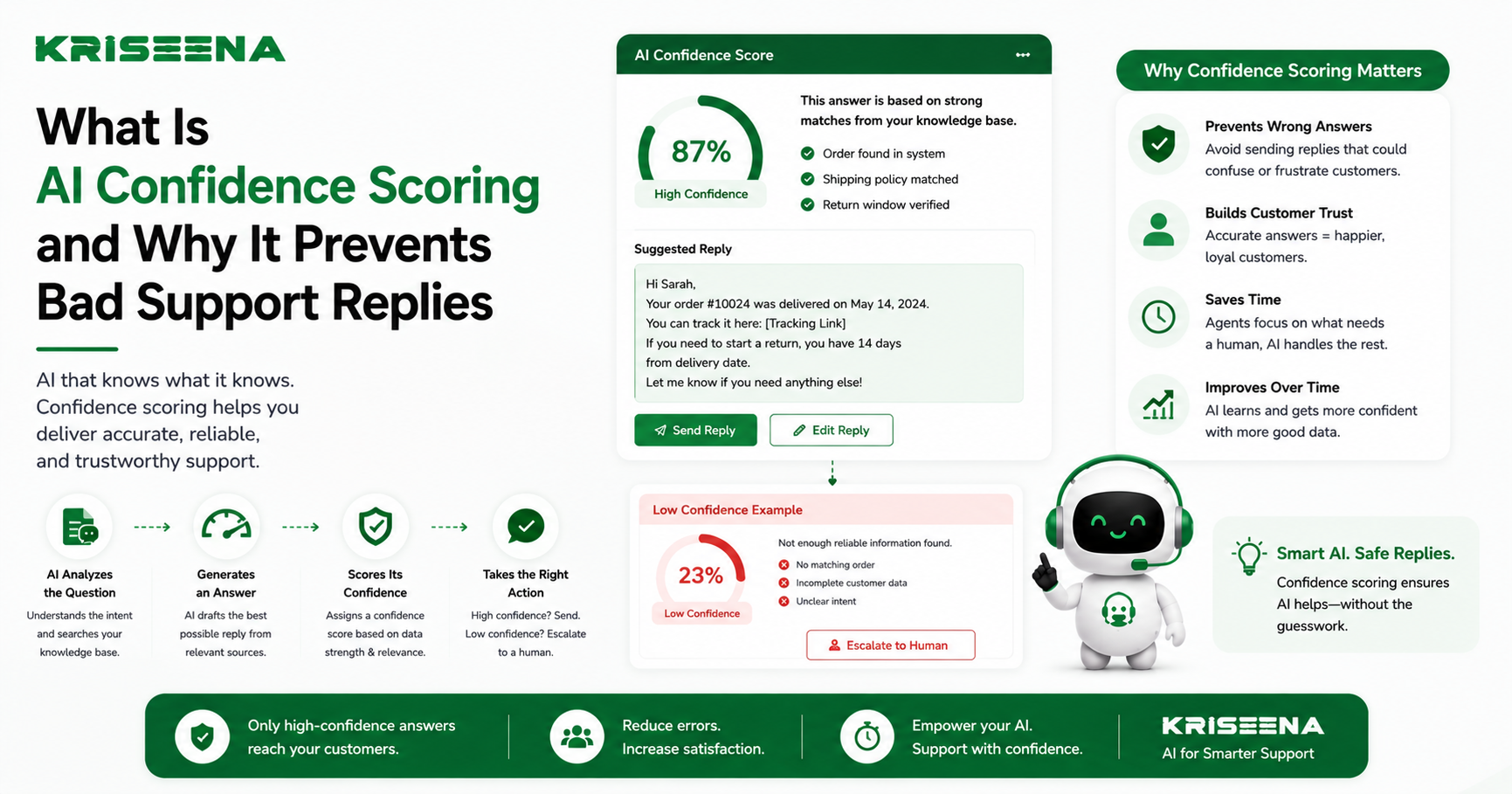
A confidence score is a number from 0 to 100 that reflects how certain the AI is that its answer is correct. Set a threshold, and the AI sends replies above it automatically while holding replies below it for a human to review. Get the number right and you cut support volume without letting wrong answers reach customers. Get it wrong and you either drown your team in reviews or ship mistakes at scale.
This guide covers how confidence scoring works, how to tune it, and how it connects to every other decision your AI support system makes: when to escalate, when to draft instead of send, how to log the reasoning, and how to spot a frustrated customer before they churn.
What Is AI Confidence Scoring?
Confidence scoring is not a single feature. It is the hub that a handful of related decisions connect to. Here is how each piece works and where to read more.
Setting your threshold. The threshold is the score above which the AI acts on its own. Set it too high and almost everything gets held for review. Set it too low and mistakes slip through. Our guide to setting your confidence threshold walks through how to pick a starting number and tune it from real data.
Handing off to a human. A low score is only useful if something happens next. The AI needs to route the conversation to a person cleanly, with full context, so the customer never repeats themselves. See how a smooth AI to human handoff should work.
Draft mode versus auto-reply. Below the threshold, the AI can either stay silent or write a draft for an agent to approve. Draft mode keeps a human in the loop while still saving most of the typing. We compare draft mode and auto-reply and when each one fits.
Logging the reasoning. When the AI escalates, you should be able to see why: the score, the source it matched, and the threshold that triggered. A proper escalation audit log turns a black box into something you can audit and tune.
Measuring deflection honestly. Confidence scoring changes how many tickets your AI handles alone, so you need an honest way to measure that. Read why deflection rate is the most gamed metric in AI support and how to calculate it correctly.
Catching frustration early. Confidence is about whether the answer is right. Frustration detection is about whether the customer is angry. The two work together: an angry customer should reach a human even when the AI is confident. See how frustration detection should escalate on sentiment, not just on score.
Probability Distributions
When a customer asks a question, the AI evaluates many possible responses.
Some responses clearly fit the available information better than others.
If one response is much more likely than the alternatives, the model is generally more confident.
If several possible answers seem equally plausible, confidence decreases because the AI has less certainty about which response is correct.
Available Context
Confidence also depends on the information available to the AI.
For example, an AI connected to:
- Order history
- Shipping information
- Knowledge base articles
- Product documentation
- Customer account data
can answer many questions with greater confidence than a model working without those sources.
Better context usually leads to more reliable responses.
Model Certainty
Confidence scoring also reflects how consistently the model arrives at a particular answer.
If the available evidence strongly supports one response, certainty is high.
If the information is incomplete, contradictory, or unclear, the confidence score decreases accordingly.
This helps distinguish between questions the AI understands well and situations where human judgement is more appropriate.
Why Confidence Scoring Matters for Customer Support
Accuracy matters far more than speed.
A fast but incorrect answer creates additional work for your support team and damages customer trust.
Common risks include:
- Incorrect refund information
- Wrong shipping updates
- Misunderstood return policies
- Inaccurate subscription details
- Conflicting product advice
Once customers receive incorrect information, fixing the mistake often takes longer than answering correctly the first time.
Confidence scoring helps prevent these situations by identifying responses that deserve human review before they reach the customer.
Why Wrong AI Replies Damage Trust
Customers are usually willing to interact with AI as long as the answers are accurate and helpful.
However, confidence disappears quickly when AI:
- Gives inconsistent information.
- Invents details that don't exist.
- Misinterprets customer questions.
- Provides outdated policies.
- Makes promises the business cannot fulfill.
Even a small number of incorrect responses can reduce confidence in both the support team and the brand itself.
Confidence scoring acts as a safeguard by reducing the chances of uncertain responses being delivered automatically.
How Draft Mode Uses Confidence Scores
One of the most practical uses of confidence scoring is AI draft mode.
Instead of automatically sending every reply, the AI first evaluates its confidence level.
The workflow typically looks like this:
High Confidence
If the response exceeds the team's chosen confidence threshold, the AI can safely send the reply automatically.
These are usually routine questions such as:
- Order status
- Shipping updates
- Return policy
- Store hours
- Account information
Automation saves agents significant time while maintaining response quality.
Low Confidence
If the confidence score falls below the threshold, the AI prepares a draft instead of sending the message.
A support agent reviews the response, makes any necessary edits, and approves it before it reaches the customer.
This approach combines the speed of AI with the judgement of experienced support staff.
Human Review
Some conversations naturally require human involvement regardless of confidence.
Examples include:
- Refund disputes
- Legal questions
- Billing exceptions
- Sensitive complaints
- Escalations
- Complex technical issues
Confidence scoring helps identify these conversations early so agents can step in without unnecessary delays.
Choosing the Right Confidence Threshold
There isn't a single confidence threshold that works for every business.
The ideal setting depends on:
- Industry
- Risk tolerance
- Customer expectations
- Support workload
- Quality of available data
For example:
A business receiving thousands of routine order status questions may choose a lower threshold because those answers rely on structured order data.
A financial services company or healthcare provider would likely use a much higher threshold because incorrect information carries greater consequences.
Many businesses begin with a conservative threshold and gradually increase automation as they gain confidence in the AI's performance.
Best Practices for Using Confidence Scoring
To get the most value from confidence scoring:
- Connect the AI to accurate business data.
- Keep your knowledge base updated.
- Monitor responses that require human review.
- Regularly review incorrect or edited AI drafts.
- Adjust confidence thresholds based on real-world performance.
- Continue training agents to recognize situations requiring personal judgement.
Confidence scoring is most effective when paired with high-quality data and clear support processes.
How Kriseena Uses Confidence Thresholds
Kriseena includes a configurable confidence threshold feature that gives support teams direct control over when AI responses should be sent automatically.
Instead of relying on a fixed confidence level, each team can choose the cutoff that matches its workflow and risk tolerance.
When the AI's confidence exceeds the selected threshold, responses can be delivered automatically for routine customer questions.
If confidence falls below that threshold, the response is held as a draft for human review rather than being sent immediately. This allows support teams to automate repetitive conversations while maintaining oversight for situations where the AI is less certain.
By allowing businesses to define their own confidence threshold, Kriseena helps teams balance efficiency with accuracy based on their unique support requirements.
Final Thoughts
AI confidence scoring isn't about making AI appear smarter. It's about making automation safer.
By estimating how certain the model is before responding, confidence scoring helps prevent incorrect answers, protects customer trust, and ensures that human agents remain involved when judgement is required.
For support managers, this creates a practical balance between automation and quality. Routine questions can be answered instantly, while uncertain responses receive the attention they deserve.
As AI becomes a larger part of customer support, features like configurable confidence thresholds will play an increasingly important role in ensuring customers receive accurate, reliable assistance.
For Shopify stores, WooCommerce merchants, and SaaS businesses, platforms like Kriseena make this balance easy to achieve by allowing teams to define their own confidence threshold, automate high-certainty responses, and send lower-confidence replies for human review before they reach the customer.