
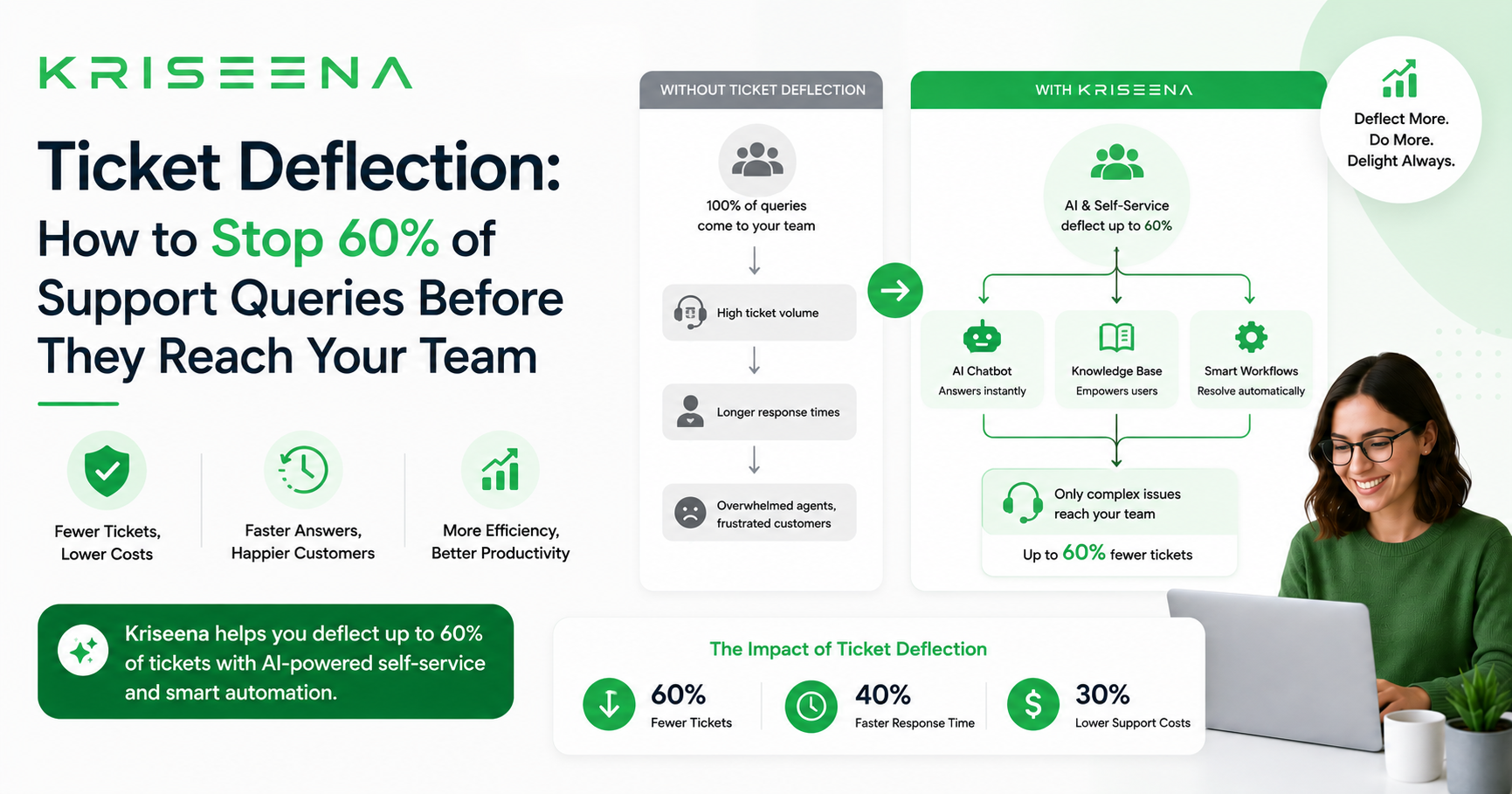
What Is Ticket Deflection?
Ticket deflection is the resolution of a customer query through a self-serve or automated channel — without the query ever reaching a human support agent. A customer who finds their answer in a knowledge base article has had their ticket deflected. A customer who receives an accurate AI reply without agent involvement has had their ticket deflected.
Deflection is not the same as avoidance. Deflection resolves the customer's need — they get an answer, they do not need to wait for an agent. The experience quality is the same or better (faster, available 24/7); the cost is a fraction of human handling.
Deflection rate = (Queries resolved without agent involvement ÷ Total queries initiated) × 100
A team with a 60% deflection rate handles 60% of its total query volume through AI or self-serve, with agents handling only the remaining 40%.
Why Ticket Deflection Matters
The economics of ticket deflection are straightforward:
| Human-handled ticket | AI/self-serve deflected | |
|---|---|---|
| Cost per resolution | £6–£15 | £0.20–£1.50 |
| Resolution time | 4–48 hours | Under 60 seconds |
| Available hours | Business hours only | 24/7 |
| Consistency | Varies by agent | Consistent |
At 500 tickets per week with a 60% deflection rate:
- 300 tickets deflected at £0.80 average = £240
- 200 tickets human-handled at £10 average = £2,000
- Total weekly cost = £2,240
Without deflection (all 500 human-handled):
- 500 × £10 = £5,000 per week
Deflection at 60% saves £2,760 per week — £143,520 per year at this volume.
The Three Deflection Layers
Effective ticket deflection works through three layers, each catching queries that would otherwise reach a human agent.
Layer 1: Proactive Communication (Deflect before the query)
The highest-leverage deflection is eliminating the query entirely by answering it before the customer asks. For e-commerce:
- Dispatch notification with tracking link (eliminates 30–40% of WISMO queries)
- Delivery delay alerts (sent proactively when delivery runs late)
- Post-purchase email sequence covering common questions (returns process, next order steps)
- FAQ visible on the product and checkout pages
These do not deflect in the traditional sense — they prevent the query from forming. The customer who knows where their order is does not contact support.
Typical deflection from Layer 1: 25–35% of potential contacts
Layer 2: Self-Serve Infrastructure (Deflect before they contact you)
Customers who cannot find an answer in proactive communication look for it themselves before contacting support. Your self-serve infrastructure determines whether they find it.
Knowledge base: 20–30 well-written articles covering top query types. Customers who search find answers. The same articles feed your AI system — the investment is used twice.
FAQ page: A well-structured FAQ on your website resolves pre-purchase doubts (sizing, shipping, returns) without a support contact.
Order tracking page: A branded, on-domain tracking experience where customers check status without contacting you.
Self-serve returns portal: A portal where customers initiate returns without sending an email. Eliminates 50–70% of return-related contacts.
Typical deflection from Layer 2: 15–25% of remaining contacts
Layer 3: AI Resolution (Deflect after they contact you)
Queries that reach your support channel are the last deflection opportunity. AI resolution handles these without human involvement.
AI deflection works for:
- Order status queries (WISMO) — AI retrieves live data and replies
- Policy questions — AI retrieves KB article and explains the policy
- FAQ queries — AI finds and answers from knowledge base
- Standard account queries — password reset instructions, account navigation
AI deflection does NOT work for:
- Emotionally charged complaints requiring human judgment and empathy
- Complex multi-issue queries requiring coordination
- Queries outside knowledge base scope with high accuracy requirements
- High-value customer escalations
Typical deflection from Layer 3: 50–70% of queries that reach the support channel
How to Measure Your Current Deflection Rate
Most support platforms show deflection rate in analytics, but the calculation depends on what channels you track.
Simple method:
- Count queries initiated in a period (chat sessions opened + emails received)
- Count queries resolved without any agent sending a reply (AI-handled + self-serve)
- Divide: deflected ÷ total initiated × 100
More precise method (3-layer):
- Count total potential contacts (estimate from order volume × historical contact rate)
- Subtract queries that never arrived (proactive communication deflection)
- Of queries that arrived, count those resolved by AI or self-serve
- Deflection rate = (never arrived + AI/self-serve resolved) ÷ total potential × 100
The 3-layer method is more accurate but requires estimating potential contacts. Start with the simple method and move to 3-layer once you have baseline data.
Setting Deflection Targets by Maturity Stage
| Stage | Deflection rate | What this looks like |
|---|---|---|
| Starting out (no AI, basic FAQ) | 10–20% | Some queries deflected by FAQ and KB |
| Early AI deployment (draft mode) | 30–45% | AI handling order status and common policies |
| Mature AI deployment | 55–70% | AI handling all tier-1 queries confidently |
| Optimised (proactive + AI + self-serve) | 65–80% | Proactive comms prevent many contacts; AI handles the rest |
Do not target 80%+ deflection as a starting goal. Deflection quality matters — a deflected ticket where the customer got an incorrect answer is worse than a human-handled ticket. Build to 60% accurately before pushing to 70%+.
Common Deflection Mistakes
Deflecting with inaccurate answers The goal of deflection is resolution — not just keeping queries away from agents. An AI that confidently sends incorrect information scores a deflection and destroys CSAT. Set confidence thresholds conservatively (75–80) and review AI accuracy before raising the threshold.
Hiding the contact option Some businesses try to increase deflection by making it hard to reach a human. This frustrates customers who have a genuine complex issue and creates resentment. Good deflection makes self-serve and AI so useful that most customers choose it — not forces them into it.
Deflecting high-stakes queries Chargeback threats, damaged luxury items, safety concerns — these should never be AI-deflected. Build exclusion rules that route these immediately to a human agent regardless of AI confidence.
Not closing the deflection loop After a deflected interaction, ask whether the customer's issue was resolved. A thumbs up/down at the end of a chat session or a post-interaction email gives you data on deflection quality, not just deflection rate.
Improving Your Deflection Rate: Practical Steps
Week 1: Add dispatch tracking email and update FAQ page. Target: +10–15% deflection.
Week 2–3: Build 10 knowledge base articles for your top query types. Deploy AI in draft mode. Target: +15–20% deflection.
Week 4: Review AI drafts. Identify query types where accuracy is above 90%. Enable auto-send for those types. Target: +15–20% deflection.
Month 2: Add self-serve returns portal. Expand KB to 20 articles. Target: +10–15% deflection.
Month 3: Review deflection analytics. Identify queries still reaching agents that AI should be handling. Fill KB gaps. Target: +5–10% deflection.
Most businesses reach 55–65% deflection rate within 90 days of focused implementation.
Key Takeaways
- Ticket deflection resolves queries without agent involvement — through proactive communication, self-serve, or AI
- Deflection reduces cost per ticket from £10+ to under £1.50, with faster resolution and 24/7 availability
- The three layers: proactive communication (prevent queries), self-serve infrastructure (catch before contact), AI resolution (handle at contact)
- Deflection rate targets: 20–30% with basic FAQ; 50–65% with mature AI; 65–80% with proactive + AI + self-serve
- Quality before quantity: a wrong AI answer scores a deflection and damages CSAT — set conservative confidence thresholds and validate accuracy before raising
- Most businesses reach 55–65% deflection within 90 days of structured implementation
Frequently Asked Questions
What is ticket deflection in customer support? Ticket deflection is the resolution of a customer support query through a channel that does not require a human agent — typically AI, a knowledge base, FAQ, or self-serve portal. A deflected ticket is one where the customer got their answer without waiting for an agent to respond. Deflection rate is the percentage of total queries resolved this way.
What is a good ticket deflection rate? A deflection rate of 60–70% is considered strong for e-commerce businesses with mature AI and self-serve infrastructure. Early-stage teams without AI typically achieve 10–20% through basic FAQ and knowledge bases. The realistic achievable range for most businesses within 90 days of structured implementation is 50–65%.
Does ticket deflection hurt customer satisfaction? Not when implemented correctly. AI deflection that provides fast, accurate answers consistently scores equal to or higher CSAT than human handling — because the response is immediate and available 24/7. Deflection hurts CSAT only when the deflected answer is inaccurate or when genuine complex issues are forced through self-serve rather than reaching a human.
How do I increase my ticket deflection rate? The highest-leverage steps are: (1) add proactive dispatch notifications and delay alerts to prevent WISMO queries forming; (2) build a knowledge base covering your top 10 query types and deploy AI in draft mode; (3) enable auto-send for query types where AI accuracy exceeds 90%; (4) add a self-serve returns portal to eliminate return contacts. In combination, these typically achieve 55–65% deflection within 90 days.
What queries should never be deflected? Emotionally charged complaints (damaged luxury items, significant financial loss), chargeback threats, safety concerns, and queries from your highest-value customers should always route to human agents regardless of AI confidence. Build exclusion rules for these categories before enabling broad AI auto-send.

Aswathi
Content Writer, Kriseena
Aswathi specialises in SaaS product content and customer experience topics. Her writing helps e-commerce founders and support managers understand how AI fits into their existing workflows.