
Why Small Businesses Leave Zendesk
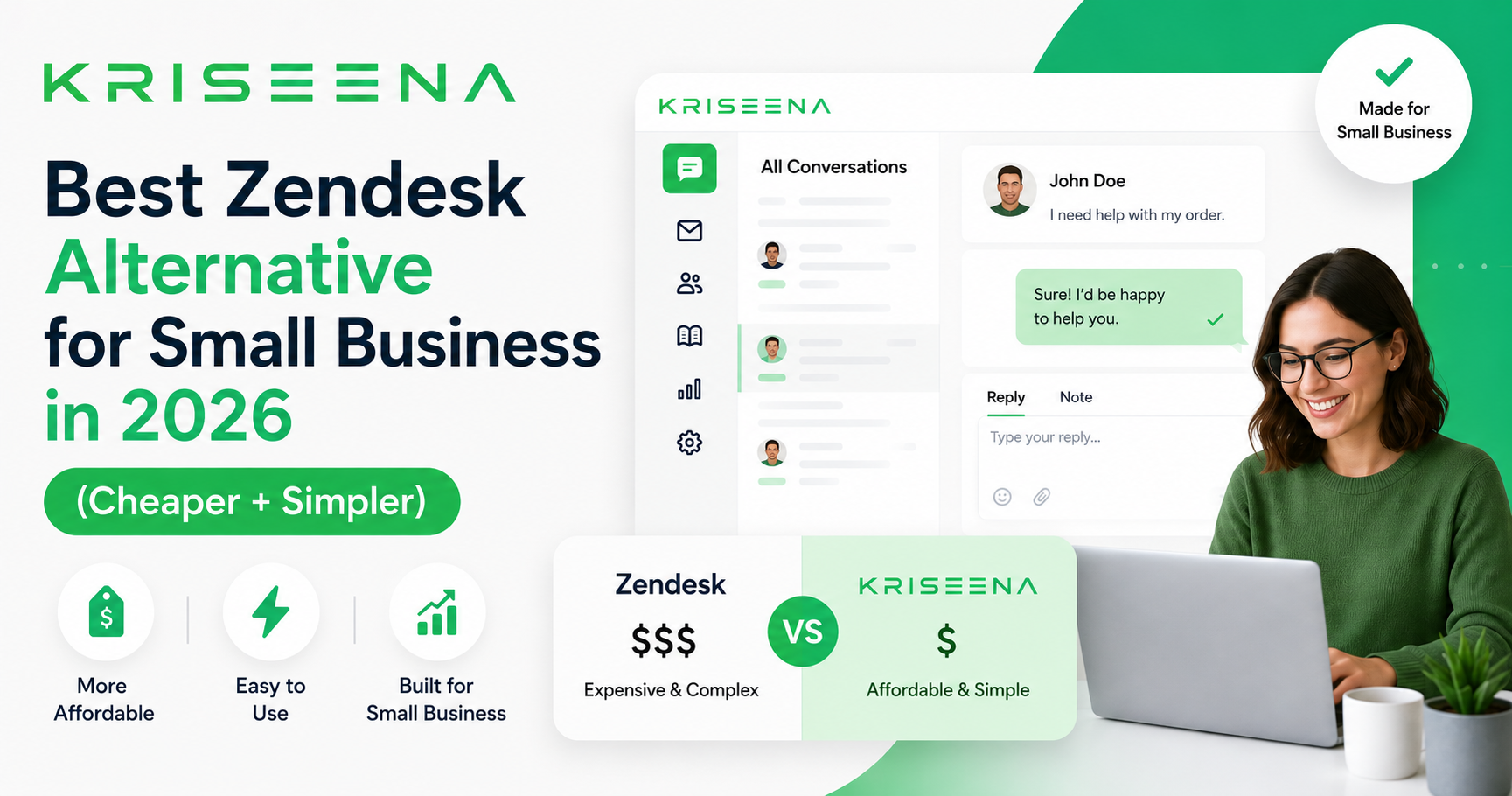
Zendesk is the market-leading help desk platform. It is also one of the most common platforms that small businesses outgrow — not upward, but sideways. They do not leave because they need more features. They leave because they are paying for features they will never use, managing complexity that does not match their team size, and absorbing price increases that are hard to justify when a two-person team handles support.
The most common complaints from small businesses leaving Zendesk:
- Pricing scales fast. The Suite Team plan starts at $55/agent/month. For a 3-agent team, that is $165/month before any add-ons. Many small businesses eventually add AI, analytics, or multi-brand support — each as a paid upgrade.
- Minimum seat requirements. Some Zendesk tiers require 5 agents minimum. A 2-person support team pays for 3 unused seats.
- Configuration overhead. Zendesk is highly configurable, which means it requires significant setup time to work well. Triggers, automations, views, macros, SLAs — a small team without a dedicated admin spends hours configuring the tool instead of using it.
- AI is an expensive add-on. Zendesk AI (formerly Answer Bot) requires the Advanced AI add-on at $50/agent/month on top of the base plan. For a small team, AI on Zendesk can cost more than alternative platforms' entire pricing.
What to Look for in a Zendesk Alternative
Before comparing alternatives, establish what you actually need. Small businesses leaving Zendesk typically need:
| Requirement | Why it matters |
|---|---|
| Flat pricing, no seat minimums | Predictable cost for small teams |
| AI included (not add-on) | Core feature for efficiency, not a premium |
| E-commerce integration (Shopify/WooCommerce) | Live order lookup is essential for e-commerce |
| Simple setup | No dedicated admin required |
| Unified inbox (email + chat) | All channels in one place |
| Knowledge base included | No extra cost for self-serve |
Anything beyond this is a nice-to-have. Avoid paying for enterprise features (custom SLA management, SAML SSO, sandbox environments) that your team will not use in the next 12 months.
Zendesk Alternatives Compared
Kriseena
Best for: E-commerce and SaaS teams of 1–25 agents who want AI included from day one.
Kriseena is built specifically for small to mid-size e-commerce and SaaS support teams. AI is core to the product — not an add-on — and connects directly to Shopify and WooCommerce for live order lookup. Setup takes a few hours, not days.
Pricing: From $49/month (3 agents, 2,000 AI messages) — no per-agent pricing, no seat minimums.
Strengths vs Zendesk:
- AI included at every tier, not a $50/agent add-on
- Native Shopify and WooCommerce integration with live order data
- No minimum seat count — works for 1-agent teams
- Setup in hours, not days
- No per-conversation AI pricing that spikes during promotions
What Zendesk does better: More mature workflow automation, broader integration ecosystem (1,000+ apps), enterprise-grade compliance features.
Freshdesk
Best for: Teams wanting a free tier to start, with room to scale.
Freshdesk offers a free plan for up to 10 agents on basic features, making it accessible for early-stage businesses. The paid tiers are more affordable than Zendesk, though AI features require the Growth tier or above.
Pricing: Free (limited); Growth from $15/agent/month; Pro from $49/agent/month.
Strengths vs Zendesk: Lower entry cost, generous free tier, simpler interface.
Weaknesses: AI (Freddy AI) requires Growth tier minimum; e-commerce integrations are less deep than Shopify-native tools; can feel feature-bloated for small teams.
Help Scout
Best for: Small SaaS and service businesses that want an email-first inbox without complexity.
Help Scout is email-focused with a clean, simple interface designed for non-enterprise teams. It is easier to set up than Zendesk and significantly cheaper at small team sizes.
Pricing: From $20/user/month (2 users minimum).
Strengths vs Zendesk: Simpler interface, faster setup, better for email-primary teams.
Weaknesses: Limited AI capability; no native e-commerce integration for live order lookup; live chat is basic compared to AI-powered alternatives.
Intercom
Best for: SaaS companies with a product-led growth model and high inbound message volume.
Intercom is a customer messaging platform with strong AI capabilities. It is, however, expensive — often more so than Zendesk at comparable feature levels for small teams.
Pricing: Starts at $74/month but scales quickly; full AI features require higher tiers.
Strengths vs Zendesk: Better conversational AI, stronger product tour and onboarding features, good for SaaS lifecycle messaging.
Weaknesses: More expensive than most alternatives for small teams; pricing complexity can make budgeting difficult; over-featured for pure support use cases.
Gorgias
Best for: Shopify-only e-commerce brands with high support volume.
Gorgias is built exclusively for e-commerce, with deep Shopify integration. It is a strong Zendesk alternative for Shopify merchants, though pricing is based on ticket volume rather than agents — which can make costs unpredictable during promotions.
Pricing: From $10/month (50 tickets) to $900+/month; charged per ticket above plan limit.
Strengths vs Zendesk: Deep Shopify integration, e-commerce-focused workflows.
Weaknesses: Per-ticket pricing spikes during sales; Shopify-only (no WooCommerce); AI features require higher tiers.
Side-by-Side Comparison
| Platform | Starting price | AI included | E-commerce integration | Setup complexity | Seat minimum |
|---|---|---|---|---|---|
| Zendesk | $55/agent/mo | Add-on (+$50/agent) | Via app marketplace | High | Varies by plan |
| Kriseena | $49/month flat | Yes, all tiers | Shopify + WooCommerce native | Low (hours) | 1 agent |
| Freshdesk | Free / $15/agent | Growth tier+ | Via integrations | Medium | 1 agent |
| Help Scout | $20/user/mo | Basic only | Limited | Low | 2 users |
| Intercom | $74/month+ | Yes (AI Agent) | Via integrations | Medium | 1 seat |
| Gorgias | $10/mo (50 tickets) | Higher tiers | Shopify native | Low | 1 seat |
How to Switch From Zendesk Without Disrupting Support
Step 1 — Export your data. Zendesk allows full data export (tickets, contacts, knowledge base articles). Export before cancelling.
Step 2 — Run parallel for 2 weeks. Set up your new platform and route new tickets to it while keeping Zendesk active for existing open tickets. Do not switch everything at once.
Step 3 — Migrate your knowledge base. Import existing KB articles into your new platform. Update any that reference Zendesk-specific processes.
Step 4 — Update your widget. Replace the Zendesk widget on your site with the new platform's embed code. Test on all pages.
Step 5 — Cancel Zendesk at the next billing cycle. Do not cancel mid-cycle unless your new platform has been running cleanly for at least one week.
Key Takeaways
- Zendesk's main drawbacks for small businesses are cost (AI is a $50/agent add-on), seat minimums, and configuration complexity
- The best Zendesk alternative depends on your use case: Kriseena for e-commerce with AI included; Freshdesk for lowest entry cost; Help Scout for email-first simplicity
- Evaluate AI capability, e-commerce integration depth, and seat minimums as your three primary criteria
- Allow 2 weeks for a parallel run before fully switching — do not migrate everything at once
- Per-ticket pricing (Gorgias) and per-agent AI add-ons (Zendesk) are the two pricing models most likely to produce budget surprises
Frequently Asked Questions
What is the best Zendesk alternative for small businesses? The best alternative depends on your industry and team size. For e-commerce businesses on Shopify or WooCommerce, platforms with native order lookup and flat pricing (rather than Zendesk's per-agent model with AI as an add-on) deliver better value. For SaaS teams, Help Scout offers simplicity; Intercom offers stronger lifecycle messaging. For pure cost reduction with a free entry tier, Freshdesk is worth evaluating.
Is Zendesk too expensive for small businesses? For teams of 1–5 agents, Zendesk's pricing model — $55/agent/month for Suite Team, plus $50/agent/month for AI — frequently exceeds what smaller businesses can justify. A 3-agent team pays $315/month for Suite Team with AI. Alternatives offering flat monthly pricing with AI included typically cost 50–80% less at this team size.
Can I migrate from Zendesk without losing my data? Yes. Zendesk supports full data export of tickets, contacts, and knowledge base content. Most alternative platforms also offer migration tools or import from Zendesk exports. The process typically takes a few days and is worth running parallel to your existing Zendesk setup for 2 weeks before full cutover.
Does Zendesk have AI customer support? Yes, Zendesk offers AI through its "Advanced AI" add-on and the newer "Zendesk AI Agent" (formerly Answer Bot). The Advanced AI add-on costs $50/agent/month on top of the base plan. Alternative platforms increasingly include AI at base pricing, making Zendesk's AI pricing a common switching trigger for cost-conscious teams.
What is cheaper than Zendesk for customer support? Almost all alternatives are cheaper than Zendesk at small team sizes. Freshdesk has a free tier. Help Scout starts at $20/user/month. Kriseena offers flat pricing from $49/month regardless of agent count up to 3 agents. Zendesk's cost advantage is at enterprise scale, where its workflow automation and compliance features justify the price.

Sushma
Content Writer, Kriseena
Sushma covers integrations, automation, and support team productivity. She breaks down complex technical setups — Shopify, WooCommerce, Jira, Zapier — into step-by-step guides anyone can follow.