
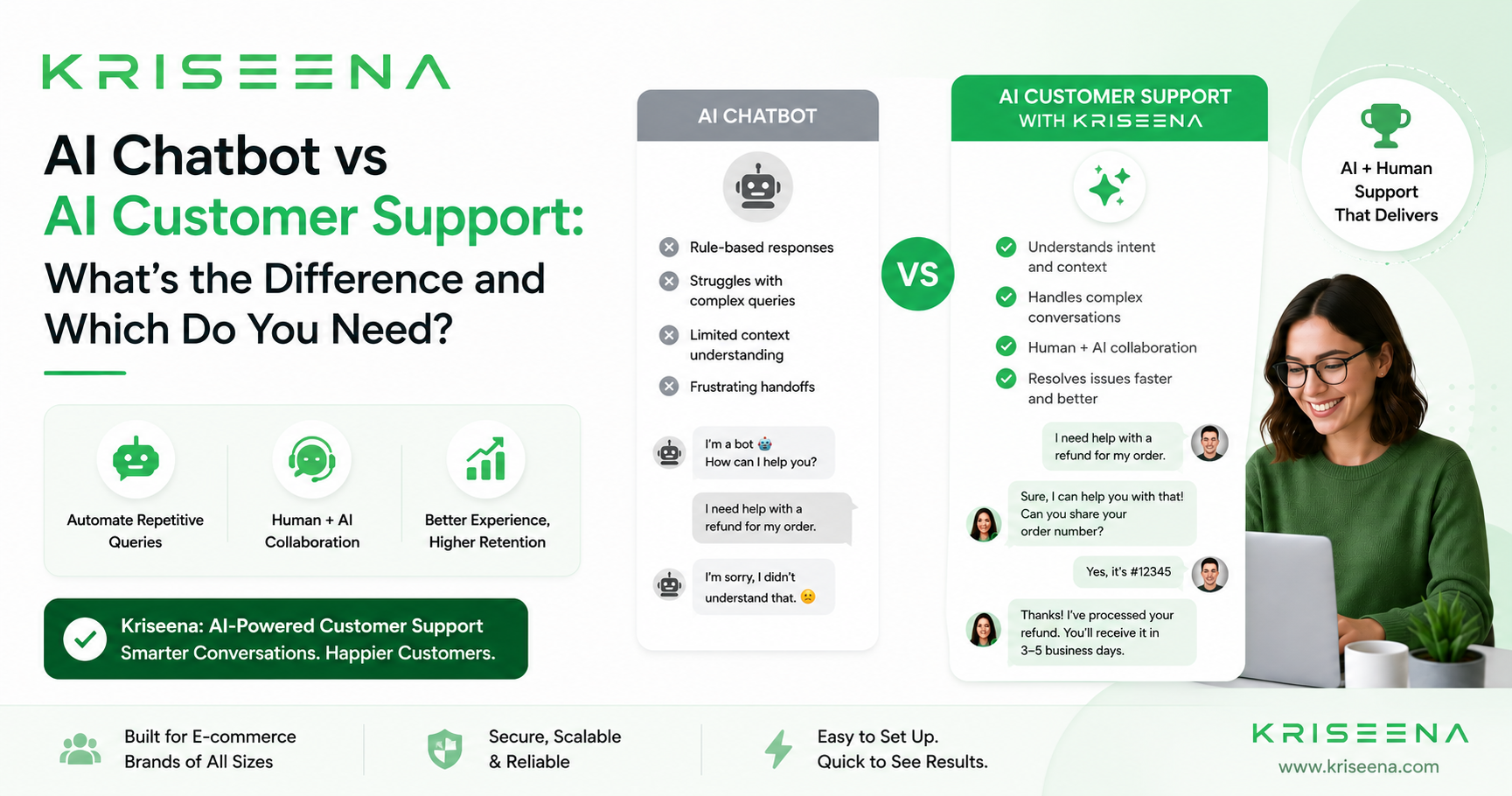
The Difference That Actually Matters
"AI chatbot" and "AI customer support" are frequently used as synonyms. They are not the same thing, and the difference significantly affects what you can realistically expect from each.
An AI chatbot is a conversational interface that follows a predefined decision tree or script. It asks questions, routes customers to answers, and follows pathways its creator built in advance. When a customer's question falls outside those pathways, the chatbot fails — it offers a fallback message or escalates to a human.
AI customer support is a fundamentally different approach. It uses a large language model (LLM) to understand the customer's intent from natural language, retrieve relevant information from a knowledge base or live data source, and generate a contextually accurate reply. It does not follow a script. It reasons about the query and constructs an answer.
The distinction matters enormously in practice.
How Rule-Based AI Chatbots Work
Traditional chatbots (including many branded as "AI") operate on decision trees:
- Customer sends message
- System matches against keyword list or intent classifier
- If match found → follow predefined path → return scripted reply
- If no match → "I didn't understand that" or "Speak to an agent"
This works for a narrow set of known queries with predictable phrasing. It fails when:
- The customer phrases a known question differently than expected
- The question involves multiple intents ("I want to return my order AND change my address for the next one")
- The question is specific to the customer's account or order data
- The customer follows up with a related but different question
Rule-based chatbots require significant ongoing maintenance — every new query type requires a new flow to be built. They are also transparent in their limitations: customers quickly learn what the chatbot "can" and "cannot" handle.
How AI Customer Support (LLM-Based) Works
LLM-based AI customer support operates differently:
- Customer sends message
- AI understands the intent from natural language (no keyword matching required)
- AI retrieves relevant knowledge base articles and/or live data (order status, account history)
- AI generates a contextually appropriate, personalised reply
- Reply is sent automatically (above confidence threshold) or sent to agent as a draft
The key differences:
Natural language understanding. The customer can say "where's my package" or "any update on my delivery" or "I've been waiting 8 days and nothing has arrived" — the AI correctly identifies all three as order status queries without separate rules for each phrasing.
Live data integration. Unlike chatbots that can only answer what was scripted, LLM-based AI connects to your Shopify or WooCommerce store and retrieves the actual order status, tracking number, and estimated delivery date for the specific customer asking.
Context retention. Within a conversation, AI remembers what was said earlier. A customer who says "and what about my other order?" gets a reply that references the previous context, not a fresh start.
Confidence scoring. LLM-based AI knows when it is uncertain. Queries below a confidence threshold are escalated to a human agent rather than generating a potentially incorrect auto-reply.
Side-by-Side Comparison
| Feature | Rule-based chatbot | LLM-based AI support |
|---|---|---|
| Understanding natural language | Keyword matching | True language comprehension |
| Handling new query phrasings | Fails unless scripted | Handles without new rules |
| Live data access (order status) | Requires custom integration per query | Built-in data retrieval |
| Multi-intent queries | Usually fails | Handles with context |
| Setup effort | High (build every flow) | Low (write KB articles) |
| Maintenance | High (update flows constantly) | Low (update KB articles) |
| Confidence scoring | No (replies or fails) | Yes (escalates when uncertain) |
| Personalisation | Limited (merge tags only) | Full (uses actual customer data) |
| Handles queries outside scope | No ("I didn't understand") | Gracefully escalates |
Real-World Example: The Same Query, Two Systems
Customer message: "Hi, I ordered something last Thursday and I'm not sure it shipped yet — my tracking email went to spam and I can't find it. Can you help?"
Rule-based chatbot response: "To track your order, please visit our order tracking page at [link] or enter your order number below."
The chatbot cannot look up the order, does not know whether it shipped, and sends the customer to a page they may have already tried. The customer has to do more work and is no more informed than before.
LLM-based AI response: "Happy to help! Your order #10482 (placed Thursday 12 June) was dispatched on Friday 13 June via Royal Mail Tracked 48. Your tracking number is RX123456789GB — you can track it here: [direct link]. It was last scanned at the Coventry sorting facility on Saturday and is estimated to arrive by tomorrow. Let me know if anything else comes up!"
The AI looked up the order using the customer's email, retrieved the dispatch date, carrier, tracking number, and latest scan, and gave a complete answer in one message.
Which Do You Actually Need?
You need a rule-based chatbot if:
- Your support queries are extremely narrow and predictable (under 10 distinct types)
- You have no budget for LLM-based AI
- You need a simple FAQ router that directs customers to the right page
You need LLM-based AI customer support if:
- You sell physical products and handle WISMO queries (order status, tracking)
- You have a growing knowledge base covering policies, products, and processes
- You want AI to generate real, contextualised replies — not just direct customers to links
- You want to handle 65–75% of support volume without human involvement
- Your customers ask questions in varied, natural ways
For any e-commerce business handling more than 20 support queries per day, LLM-based AI customer support delivers significantly better results than rule-based chatbots — because the queries are inherently varied, data-dependent, and context-specific.
The "AI-Powered" Marketing Problem
Many platforms label rule-based chatbots as "AI-powered." They are not technically wrong — keyword classifiers and decision trees can use machine learning components. But the customer experience and resolution capability are fundamentally different from LLM-based systems.
When evaluating an "AI customer support" tool, ask:
- Can it look up a specific customer's order in real time? (If no: it is not connected to live data)
- Can it handle a question it has never seen the exact phrasing of before? (If no: it is rule-based)
- Does it generate replies, or select from pre-written answers? (Pre-written = scripted chatbot)
- What happens when it is not confident in the answer? (No escalation logic = no confidence scoring)
Key Takeaways
- Rule-based chatbots follow scripts; LLM-based AI understands natural language and generates replies
- The practical difference: chatbots direct customers to links; AI answers their specific question with their specific data
- LLM-based AI handles natural language variation, live data lookup, and multi-intent queries — chatbots fail at all three
- For e-commerce, WISMO queries require live data access — chatbots cannot handle these properly
- When evaluating tools, ask: can it look up a real order? Can it handle a question phrased differently than expected? Does it confidence-score its replies?
- Most "AI-powered" chatbot marketing describes rule-based systems with machine learning components — not LLM-based customer support
Frequently Asked Questions
What is the difference between an AI chatbot and AI customer support? A traditional AI chatbot follows a predefined decision tree — it matches customer messages to scripted pathways and returns pre-written answers. LLM-based AI customer support uses a large language model to understand natural language, retrieve information from a knowledge base and live data sources, and generate contextualised replies to the specific customer's question.
Are AI chatbots good for customer support? Rule-based chatbots work for a narrow set of predictable, FAQ-style queries with simple answers. They fail on queries that involve live data (order status), varied phrasing, or multi-intent questions. For e-commerce support, where most queries involve specific customer orders and shipping data, LLM-based AI is significantly more effective.
What is a large language model (LLM) in customer support? A large language model is an AI system trained on large amounts of text that can understand and generate natural language. In customer support, LLMs enable AI to read a customer's message, understand their intent without keyword matching, retrieve relevant information, and write a contextually accurate reply — rather than selecting from pre-written scripts.
Can AI replace live chat for customer support? AI can handle the majority of live chat queries autonomously — typically 65–75% for e-commerce businesses. The queries AI handles best are routine, factual, and data-driven: order status, returns policy, product questions. Complex, sensitive, or multi-issue queries should still route to human agents. The best approach is AI handling tier-1 volume with seamless escalation for queries that require human judgment.
How do I know if a tool uses real AI or just a chatbot? Ask the vendor to demonstrate: (1) a query phrased in an unusual way that still gets correctly answered, (2) a live order lookup using a real order number, and (3) what happens when the AI is not confident. A rule-based chatbot will fail (1) if the phrasing is not in its training set, cannot do (2) without a pre-built integration for that exact query type, and will not have a concept of (3). Genuine LLM-based AI passes all three.

Aswathi
Content Writer, Kriseena
Aswathi specialises in SaaS product content and customer experience topics. Her writing helps e-commerce founders and support managers understand how AI fits into their existing workflows.