
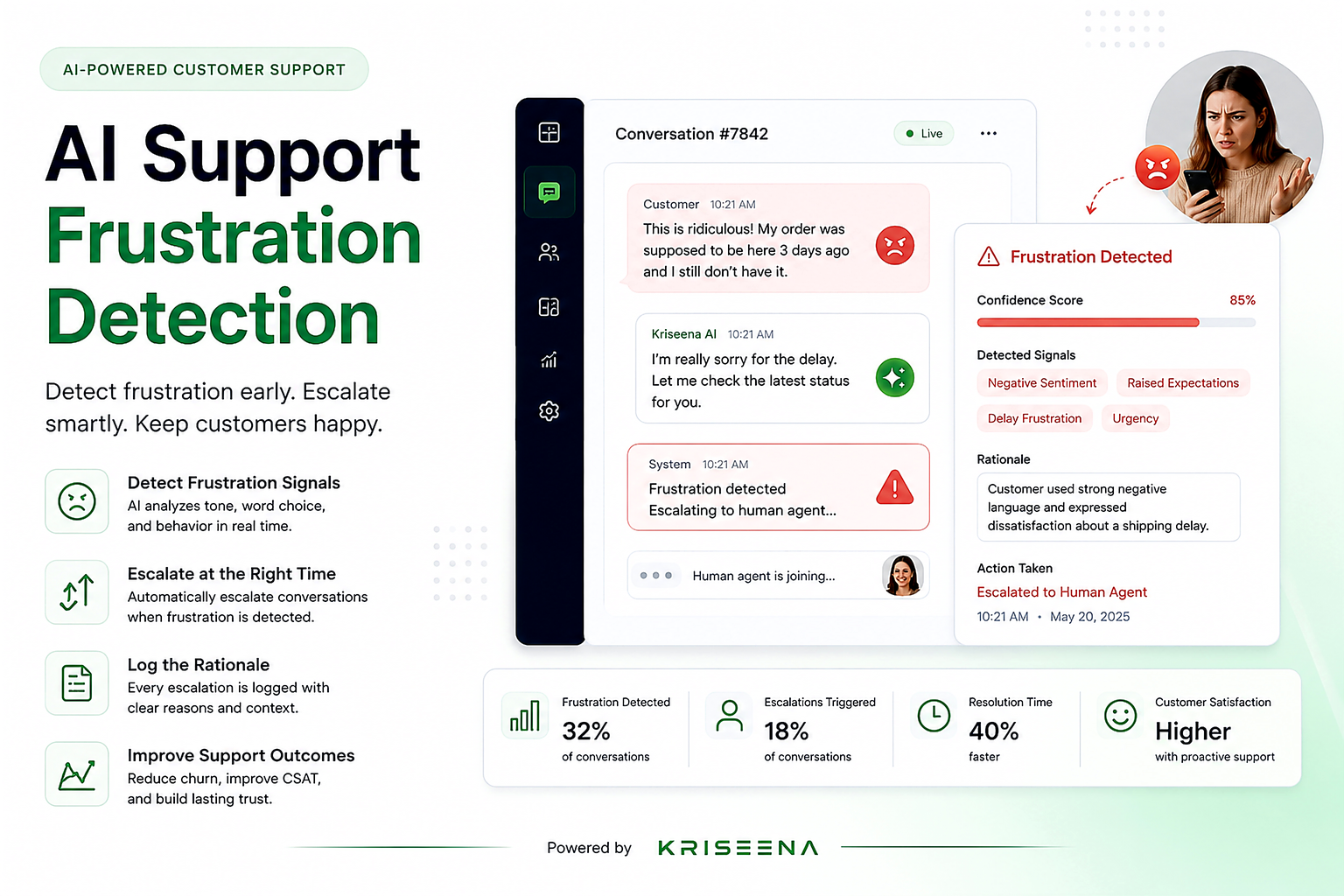
AI Support Agents Customer Frustration Detection: Knowing When AI Should Step Aside
Customer support AI is excellent at answering common questions, but it can also make a bad situation worse if it fails to recognize when a customer is becoming frustrated.
Many AI systems treat frustration detection as simple sentiment analysis. They classify messages as positive, neutral, or negative and continue responding. Real customer frustration is much more complex.
The best AI support agents customer frustration detection systems monitor behavioral patterns, conversation history, language changes, and confidence scores—not just emotional words.
When frustration is detected early, AI can adjust its tone, prioritize faster responses, or immediately transfer the conversation before the customer leaves a negative review, requests a refund, or cancels entirely.
Why Sentiment Alone Isn't Enough
Traditional sentiment detection customer support models look for emotional language.
For example:
-
"I'm disappointed."
-
"This is terrible."
-
"Great service."
While useful, these messages only capture obvious emotion.
Many customers become frustrated without using emotional words.
Examples:
Where is my order?
Five minutes later:
I already asked where my order is.
Later:
Can somebody actually answer me?
None of these contain obvious negative sentiment, yet frustration is increasing rapidly.
Good AI watches conversation behavior—not just vocabulary.
Customer Frustration Signals Every AI Should Monitor
1. Repeated Rephrasing
Customers naturally repeat themselves when they believe nobody understands them.
Example:
-
Where is my package?
-
Can someone tell me where my shipment is?
-
Has my order shipped yet?
Although the wording changes, the intent stays the same.
What it predicts
Repeated rephrasing usually indicates:
-
Loss of trust
-
AI misunderstanding
-
Low confidence in responses
If ignored, customers often stop cooperating with automation entirely.
2. ALL CAPS
Not every uppercase message means anger.
Examples:
ORDER STILL NOT HERE
or
PLEASE ANSWER
Caps combined with repeated questions generally indicate increasing urgency.
What it predicts
-
Higher probability of escalation
-
Lower customer patience
-
Increased likelihood of poor CSAT
The AI should reduce automation and prepare for human intervention.
3. Messages Keep Getting Longer
One of the strongest frustration indicators is message expansion.
Instead of asking:
Where is my order?
Customers begin writing:
I ordered this two weeks ago. I've contacted support three times already. Every time I receive the same automated response. Nobody is helping me.
Longer messages usually mean the customer is trying harder to be understood.
What it predicts
-
High emotional investment
-
Declining confidence
-
Higher churn risk
Length alone isn't enough, but rapid growth in message size is a valuable signal.
4. Explicit Cancellation Threats
Statements such as:
-
I'm cancelling.
-
Refund me.
-
I'll never order again.
-
I'm switching providers.
These require immediate attention.
What it predicts
-
Revenue risk
-
Retention risk
-
Public complaint risk
AI should stop attempting complex automation.
5. Public Review Threats
Examples include:
-
I'll leave a one-star review.
-
I'll post this online.
-
I'm contacting consumer protection.
These messages indicate reputational risk rather than simple dissatisfaction.
Immediate escalation is generally the safest response.
6. Multiple Contacts About the Same Order
Conversation history matters.
If the customer has contacted support:
-
yesterday
-
today
-
through email
-
through live chat
the frustration score should increase automatically.
The current message might appear polite, but the customer's patience is already exhausted.
This is one of the most overlooked customer frustration signals support tickets should track.
Tiered Response Model
Frustration LevelSignalsAI ActionMonitorSlightly negative wording, first complaint, minor delayContinue helping, simplify responses, monitor conversationSoftenRepeated rephrasing, longer messages, increasing urgency, confidence droppingUse empathetic language, shorten replies, prioritize resolution, prepare escalationEscalate ImmediatelyCancellation threats, legal threats, repeated contacts, review threats, abusive language, very low confidenceStop automation and begin handing off to a human agent immediately
Automation should become less aggressive as frustration increases.
Escalating Too Late: A Common Failure
Consider this conversation.
Customer:
Where is my order?
AI:
Your package is in transit.
Customer:
That's what you told me yesterday.
AI:
Your package is in transit.
Customer:
This is ridiculous.
AI:
Your package is in transit.
Customer:
Cancel my order.
At this point, the damage is already done.
The correct escalation should have happened after the second message.
The AI already knew:
-
the customer contacted support previously
-
the question was repeated
-
confidence was decreasing
-
trust had collapsed
Waiting for explicit anger is often waiting too long.
How Confidence Scoring Improves Frustration Detection
Frustration alone should not determine escalation.
It should work alongside confidence scoring.
Consider two examples.
High frustration + High confidence
The AI knows exactly where the package is.
Instead of escalating immediately, it may provide:
-
shipment updates
-
compensation policy
-
delivery estimates
The issue is emotional rather than informational.
High frustration + Low confidence
The AI isn't certain about:
-
order status
-
warehouse issue
-
refund policy
-
carrier exception
Automation becomes dangerous.
Low confidence combined with growing frustration should trigger immediate transfer.
Confidence prevents AI from pretending to know the answer.
Why Non-English Frustration Detection Is Harder
Many support platforms are trained primarily on English.
Customers communicating in:
-
Arabic
-
Hindi
-
Japanese
-
Spanish
-
mixed-language conversations
often express frustration differently.
Problems include:
Indirect language
Some cultures avoid direct complaints.
Instead of saying:
I'm angry.
They may say:
This has become difficult.
Literal sentiment models often classify this as neutral.
Code Switching
Customers frequently mix languages.
Example:
Order abhi tak nahi mila. Please check.
or
Habibi this isn't acceptable.
Many sentiment systems struggle with multilingual context.
Translation Errors
Some platforms translate messages before analyzing them.
Translation removes:
-
emphasis
-
sarcasm
-
cultural meaning
-
idioms
As a result, frustration scores become less reliable.
Modern AI should analyze messages in their original language whenever possible rather than relying solely on translation.
Frustration Detection Should Learn From Conversation History
Individual messages rarely tell the whole story.
A customer who says:
Thanks.
might actually be ending the conversation because they have given up.
Historical context reveals much more.
Useful signals include:
-
Number of previous conversations
-
Same issue reopening
-
Previous escalations
-
Previous refund requests
-
Previous failed resolutions
Without history, AI only sees snapshots.
With history, it sees patterns.
What AI Should Do at Each Stage
As frustration increases, AI behavior should change.
Early stage
-
Continue solving the issue
-
Use concise language
-
Confirm understanding
Medium stage
-
Reduce unnecessary explanations
-
Avoid repetitive responses
-
Offer faster resolution paths
-
Prepare human availability
High stage
-
Stop automated troubleshooting
-
Preserve conversation context
-
Transfer immediately
-
Notify agents about detected frustration signals
The goal is not to automate every conversation.
The goal is to automate only while automation is helping.
Best Practices for AI Frustration Detection
Effective systems combine multiple signals instead of relying on one metric.
A robust model should:
-
Track repeated questions
-
Detect conversation history across channels
-
Monitor message growth
-
Watch for cancellation or review threats
-
Combine frustration with confidence scores
-
Escalate before trust is lost
-
Adapt to multilingual conversations
-
Continuously learn from resolved cases
This approach reduces unnecessary escalations while ensuring high-risk conversations receive immediate attention.
Conclusion
Effective AI support agents customer frustration detection goes far beyond assigning a positive or negative sentiment score. The strongest indicators often come from behavioral changes: repeated rephrasing, longer messages, multiple contacts about the same issue, and explicit threats to cancel or post publicly.
When these signals are evaluated alongside confidence scoring, AI can decide whether to continue assisting, soften its approach, or begin handing off to a human agent before the customer experience deteriorates. That balance helps teams protect support SLA targets, reduce churn, and deliver better outcomes without over-automating sensitive conversations.
For a broader strategy on de-escalation, read our guide on handling frustrated customers and how AI and human agents can work together effectively.

Amrutha Suresh
Content Writer, Kriseena
Amrutha writes about AI customer support, e-commerce operations, and help desk best practices. She covers practical guides for support teams looking to scale without growing headcount.