
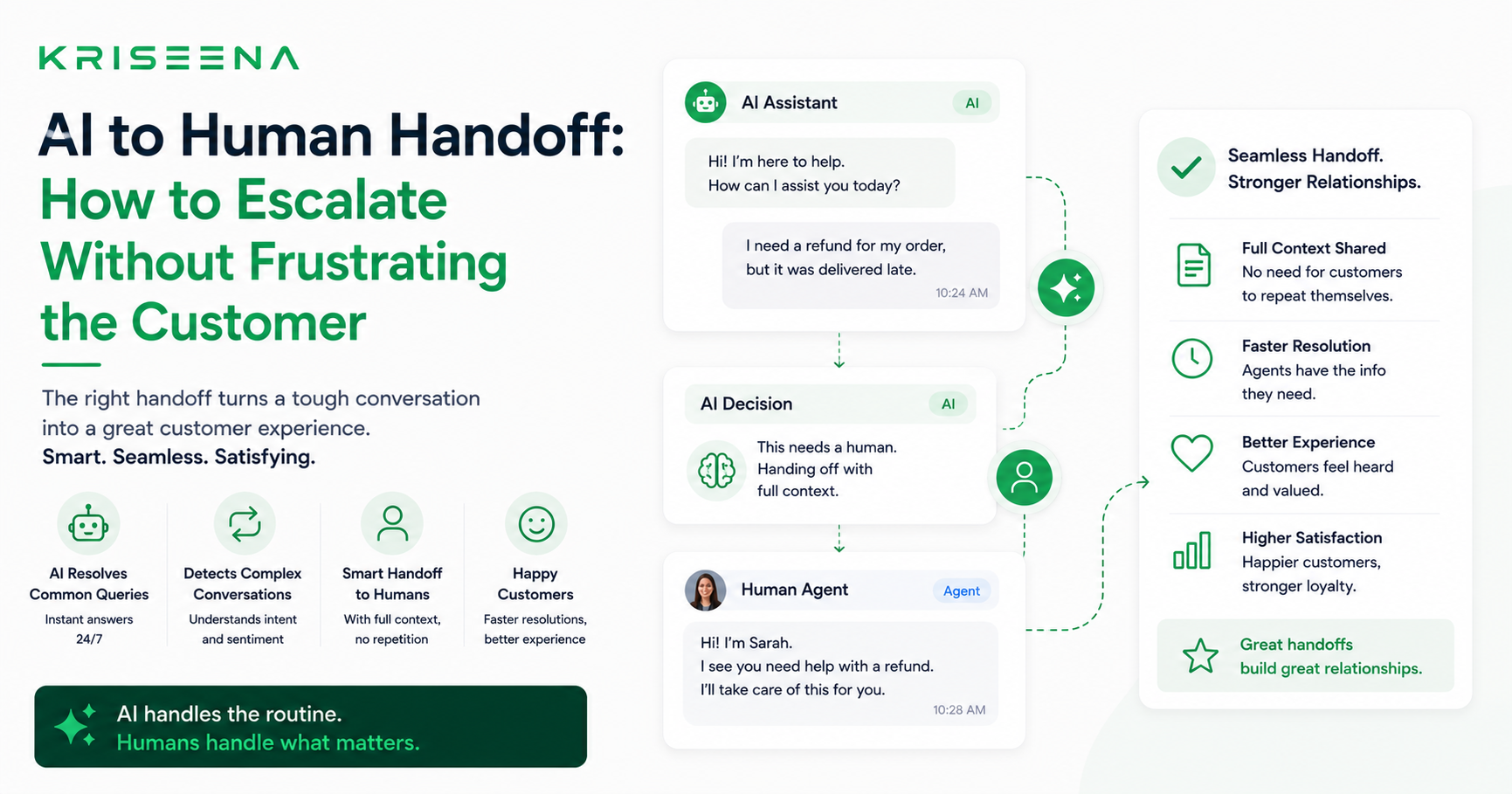
AI to Human Handoff: How to Escalate Without Frustrating the Customer
The hardest moment in AI-assisted customer support is not when the AI answers incorrectly. It is when the AI recognises it cannot help and needs to involve a human. Done badly, this feels like being passed from a useless robot to an unavailable person. Done well, it is seamless — the customer barely notices the transition, and the human agent picks up with full context.
This guide covers how to design an AI to human handoff that keeps customers confident and reduces the frustration that makes escalations worse.
Why Handoffs Go Wrong
Most bad handoff experiences share the same failure modes:
The AI refuses to acknowledge its limits. Some AI tools give vague or incorrect answers rather than escalating. The customer gets wrong information, acts on it, and the problem gets worse. By the time a human is involved, the customer is angrier than they would have been if the AI had escalated immediately.
The customer has to repeat themselves. The AI collects information, escalates, and the human agent asks the same questions again. This signals that the previous conversation was wasted and that the business's systems do not communicate. It is one of the most reliable ways to frustrate a customer.
The handoff is invisible. The customer thinks they are still talking to a bot when they are talking to a human, or vice versa. This creates confusion, especially when the human response style is different from the AI's.
The handoff takes too long. "A team member will be with you shortly" followed by silence for 30 minutes is worse than no handoff message at all.
When to Trigger a Handoff
The decision about when to involve a human should be explicit, not left to chance. Common triggers include:
Confidence threshold. If the AI's confidence in its reply falls below a set threshold, it should escalate rather than guess. In Kriseena, this threshold is configurable — you decide how cautious the AI is.
Sentiment detection. When a customer is clearly frustrated — negative language, all-caps, multiple follow-up messages — the conversation should be escalated regardless of query type. Frustrated customers do not want AI; they want acknowledgement from a person.
Specific keywords. Words like "refund," "legal," "lawyer," "report," "complaint," "chargeback," and "disgraceful" are strong signals that a human should be involved. These can be configured as automatic escalation triggers.
Query complexity. Some query types should always involve a human: account closures, billing disputes, fraud concerns, health and safety issues. These are not suitable for AI resolution regardless of confidence.
Customer request. If a customer explicitly asks to speak to a person, escalate immediately. Pushing back with more AI responses when a customer has asked for a human is one of the fastest ways to lose that customer.
How to Do the Handoff Well
Step 1: Acknowledge and set expectations clearly
The moment a handoff is triggered, tell the customer what is happening and when they will hear back. Be specific:
Good: "I am passing this to our team now. A member of staff will reply within 30 minutes." Bad: "Let me connect you with a team member."
The first tells the customer what to expect. The second leaves them wondering if anything has happened.
Step 2: Pass full context to the agent
The agent receiving a handoff should never need to re-read the conversation to understand what has happened. Kriseena provides agents with the full conversation history, the AI's confidence score, the reason for escalation, and any order data it retrieved. The agent can read a two-line summary and reply immediately.
Step 3: Do not make the customer repeat themselves
If the AI has already collected the customer's order number, email address, or problem description, that information should be visible to the agent before they respond. The agent's first message should reference what has already been shared — "I can see you're asking about order #4821" — not ask for it again.
Step 4: Transition naturally
The first human message in a handoff should feel like a continuation of the conversation, not a reset. Use the customer's name if known. Reference what they said. Acknowledge any wait. Then address the issue.
Example: "Hi Sarah, I've picked up your conversation about the delayed delivery on order #4821. I can see it was dispatched on the 18th — let me look into why it hasn't arrived yet."
This takes 10 seconds to write and dramatically changes the customer's perception of the handoff.
Step 5: Close the loop on the AI side
After the human resolves the query, the resolution should feed back into the AI. If the AI failed to answer a particular question, that is a signal to add or update a knowledge base article. If the same escalation reason is appearing repeatedly, it should be addressed at the system level, not just handled case by case.
What a Good Handoff Looks Like in Practice
Customer: "I've been waiting four weeks for my order. I'm absolutely furious. This is not acceptable."
Kriseena AI detects: High negative sentiment, delay complaint, word "furious" → triggers immediate escalation.
AI response: "I completely understand your frustration, and I'm sorry this has taken so long. I'm passing your message to our team right now — a member of staff will reply to you within 15 minutes with a full update on your order."
Agent receives: Conversation history, customer email, order lookup result (order #4821, dispatched 4 weeks ago, marked as in transit, no delivery scan for 3 weeks).
Agent response (within 15 minutes): "Hi Sarah, I'm looking at your order right now. I can see it was dispatched four weeks ago and there has been no tracking update for three weeks — that is not acceptable and I'm going to resolve this for you today. [Specific resolution offered]."
The customer got an immediate acknowledgement, a clear expectation, and a human who picked up with full context. That is what a good handoff looks like.
Summary
AI to human handoffs are inevitable — no AI resolves every query. The quality of the handoff determines whether the customer stays or leaves. Get the trigger right, pass context completely, set expectations clearly, and make the human response feel like a continuation rather than a reset.
Kriseena's sentiment detection and draft escalation features make handoffs seamless. Try it free for 14 days at kriseena.com.

Aswathi
Content Writer, Kriseena
Aswathi specialises in SaaS product content and customer experience topics. Her writing helps e-commerce founders and support managers understand how AI fits into their existing workflows.