
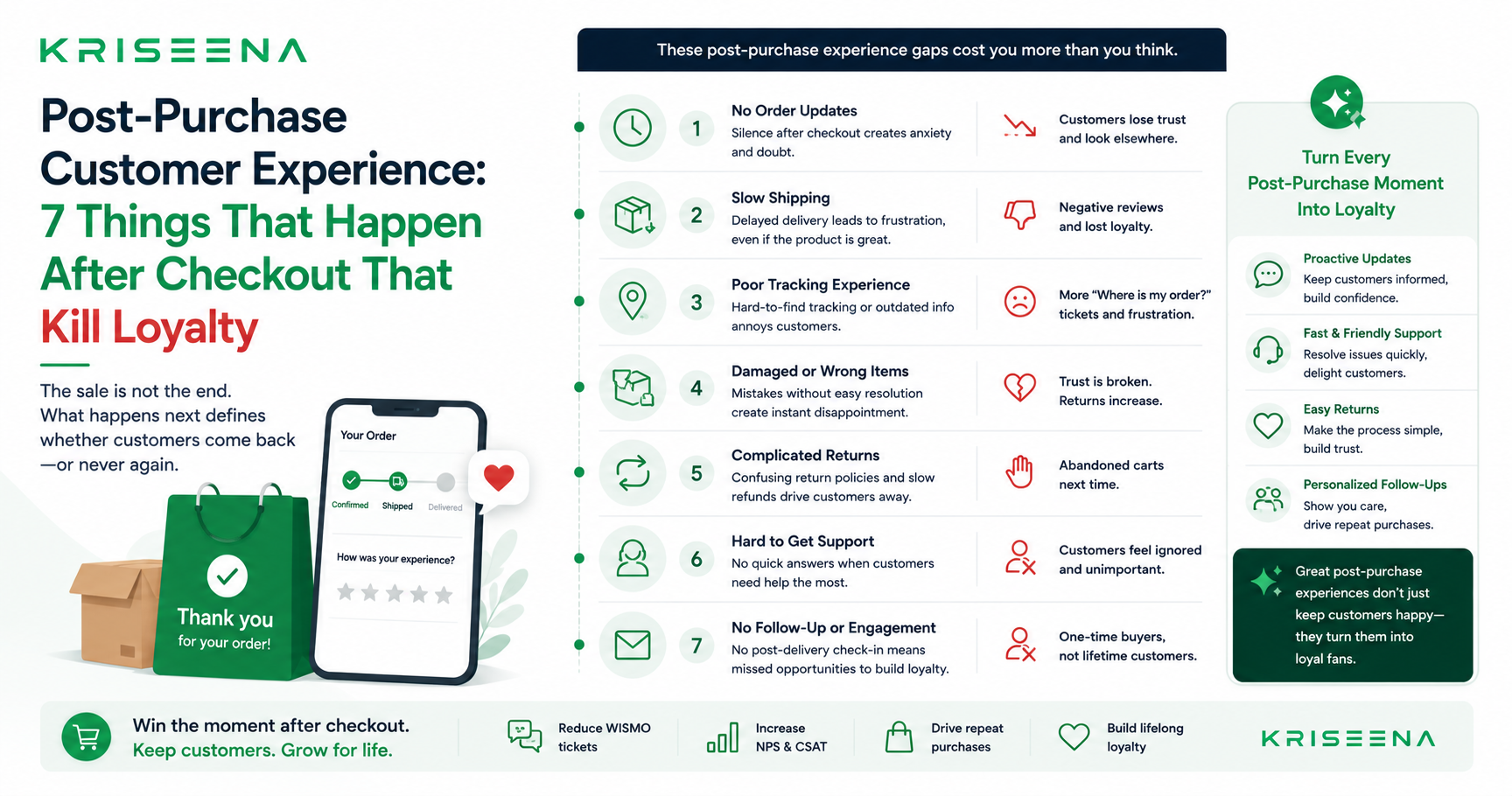
Post-Purchase Customer Experience: 7 Things That Happen After Checkout That Kill Loyalty
The moment a customer clicks "Place Order" is not the end of the sale. It is the beginning of the post-purchase experience — a period that determines whether the customer shops with you once or becomes a repeat buyer.
Most e-commerce businesses invest heavily in the pre-purchase experience: product pages, photography, reviews, checkout optimisation. The post-purchase period often receives far less attention. But it is where loyalty is built or destroyed.
This guide covers the seven most common post-purchase failures, what they cost you, and how to fix them.
1. No Dispatch Notification
The most common post-purchase failure is also the simplest to fix. A customer places an order, receives an order confirmation, and then hears nothing until a parcel appears at their door — or does not.
The gap between order placement and dispatch notification is when customer anxiety peaks. Customers check their email, wonder if the order went through, wonder when it will arrive, and — if the gap is long enough — contact support.
The fix: Send a dispatch notification the moment an order is marked as shipped. Include the tracking number, carrier, direct tracking link, and estimated delivery date. This single email eliminates a significant portion of WISMO support contacts.
2. Vague or Missing Tracking Information
A dispatch notification that says "your order has been shipped — it will arrive in 3 to 5 days" without a tracking link is nearly useless. Customers want to know exactly where their parcel is. A tracking link lets them check independently without contacting you.
Vague delivery estimates — "3 to 5 business days" — also generate more contacts than specific dates. Customers do not know whether to count from order date or dispatch date, whether weekends are included, or what happens when the estimate passes.
The fix: Include a direct tracking link (not just the carrier name and tracking number), a specific estimated delivery date, and your support address in case the tracking page is unclear.
3. Delivery Delays With No Proactive Communication
Carriers miss delivery windows. Customs delays happen. Weather affects logistics. These events are outside your control. Your communication around them is not.
When a shipment is delayed, customers who are told proactively — before they notice — respond significantly better than customers who discover the delay themselves. A simple email saying "we have noticed your delivery has been delayed by the carrier — here is the updated estimate and what we know so far" changes the experience entirely.
Customers who discover delays themselves and then contact support are starting from frustration. Customers who were told proactively are starting from trust.
The fix: Monitor delivery status and trigger proactive delay notifications when shipments pass their estimated date without a delivery scan.
4. Slow Response to Post-Purchase Queries
A customer who emails after purchase with a question — about their order, about a return, about a product — is in a different mindset than a pre-purchase visitor. They have already committed. Their trust is conditional on how the business handles the next interaction.
A slow response to a post-purchase query signals that the business was more interested in getting the sale than in serving the customer. Response times above 4 hours for email, or above 5 minutes for chat, materially reduce the likelihood of a repeat purchase.
The fix: Use AI to handle routine post-purchase queries instantly (tracking, returns policy, delivery estimates). Use drafts to speed up agent responses for complex queries. Set a response time SLA and monitor it weekly.
5. Complicated Returns Process
Customers who need to return an item are already in a negative situation. The experience of initiating the return determines whether they shop with you again.
A complicated returns process — hidden policy, confusing instructions, slow acknowledgement, unclear refund timeline — turns a neutral situation (a return) into a negative one (a frustrated customer who tells others). A simple, fast, well-communicated returns process turns the same situation into an opportunity to demonstrate excellent service.
The fix: Make your returns policy easy to find (linked in dispatch emails, in your chat widget, on a dedicated /returns page). Use AI to acknowledge return requests instantly with clear instructions. Keep humans in the loop for processing, but automate the communication.
6. No Post-Delivery Check-In
Most businesses never contact a customer after a delivery confirmation. This is a missed opportunity on two fronts.
First, it misses problems. Items that are delivered but damaged, lost after delivery, or wrong are much easier to resolve in the first 48 hours than after several days. A brief "did everything arrive safely?" message catches these early.
Second, it misses the loyalty moment. A brief, genuine post-delivery check-in signals that you care about the outcome, not just the transaction. This is the moment that converts a one-time buyer into a repeat customer.
The fix: Send a short post-delivery message 2 to 3 days after confirmed delivery. Keep it brief and human. It does not need to be a survey or a promotion.
7. No Path Back to Purchase
The post-purchase period is the highest-intent moment in a customer's relationship with your brand. They have bought, they have received the item (hopefully positively), and they are thinking about you.
Most e-commerce businesses make no effort to connect this moment to the next purchase. There is no product recommendation, no loyalty prompt, no personalised offer — just silence until the next promotional email blast goes out.
The fix: Time a follow-up message 7 to 14 days after delivery with a relevant recommendation or a simple loyalty offer. Keep it relevant to what they bought. This is not spam — it is completing the post-purchase journey.
The Business Case for Getting Post-Purchase Right
Repeat customers spend 67 percent more per order than first-time buyers, according to research from Bain & Company. Customer acquisition costs are 5 to 7 times higher than retention costs. The post-purchase experience is the highest-leverage investment in long-term revenue — and most businesses underinvest in it dramatically.
Fixing the seven failures above does not require a large team or expensive tools. It requires clear communication, fast responses, and a structured approach to what happens after checkout.
Kriseena automates post-purchase communication and support. WISMO queries answered in 15 seconds, returns acknowledged instantly, sentiment detection for frustrated customers. Start your free 14-day trial at kriseena.com.

Aswathi
Content Writer, Kriseena
Aswathi specialises in SaaS product content and customer experience topics. Her writing helps e-commerce founders and support managers understand how AI fits into their existing workflows.