
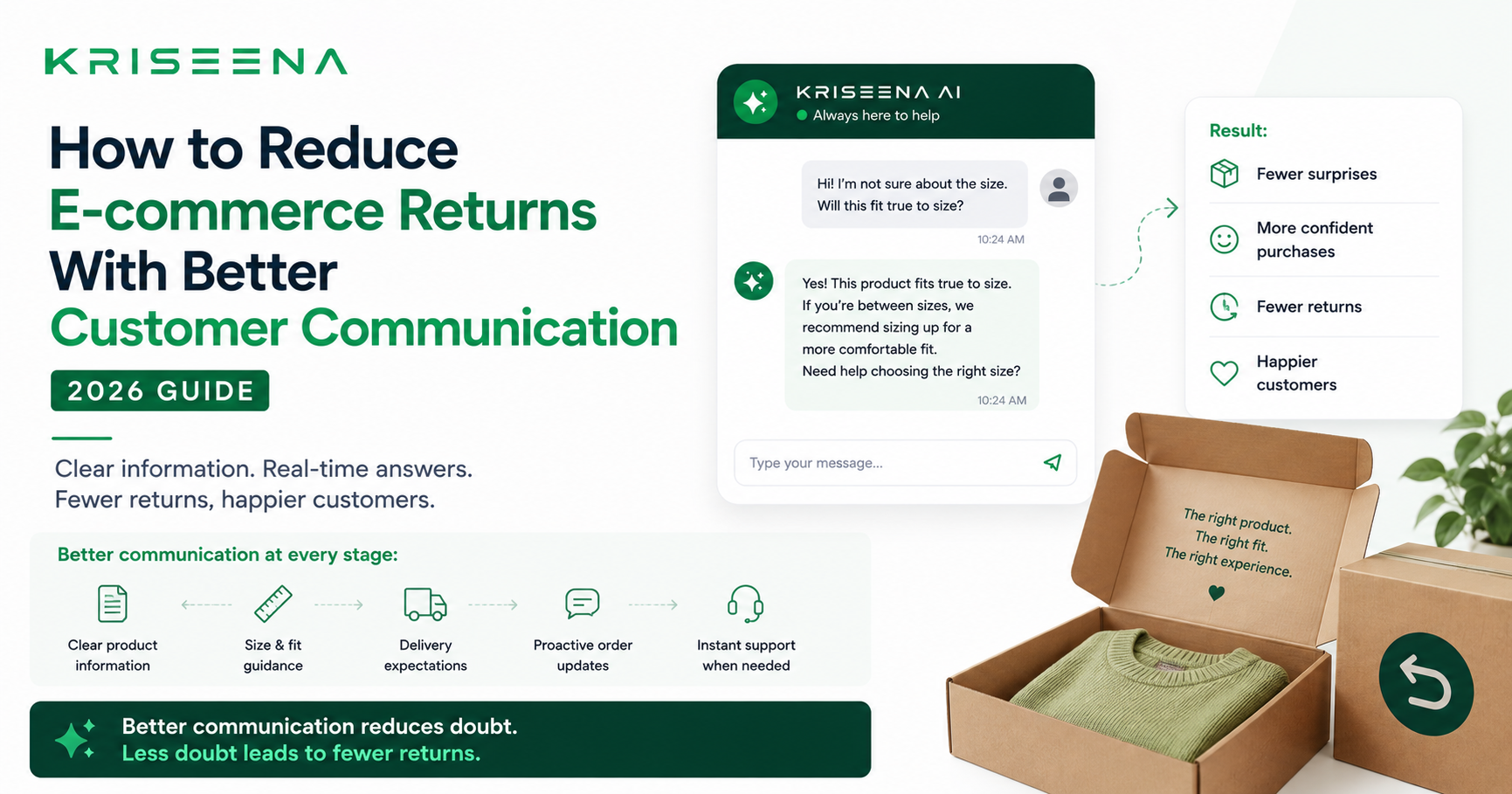
How to Reduce E-commerce Returns With Better Customer Communication (2026 Guide)
E-commerce returns are one of the most expensive problems a growing store faces. The average return rate for online retail sits between 20 and 30 percent — compared to under 10 percent in physical retail. For apparel, it can exceed 40 percent. Each return costs the business not just the logistics fee, but the customer service time, the restocking cost, and often the lost sale.
Most return-reduction advice focuses on product pages — better photos, size guides, detailed descriptions. That is good advice. But it misses a significant contributor: poor communication after the order is placed. Customers who feel informed and supported are less likely to return items out of anxiety, confusion, or frustration.
This guide covers the communication-side strategies that reduce return rates, and how AI customer support tools can implement them at scale.
Why Customers Return Items (And Which Reasons Are Preventable)
Not all returns can be prevented. A customer who ordered the wrong size, received a defective item, or changed their mind will return regardless of your communication. But research consistently shows that a meaningful share of returns are driven by factors you can influence:
- Anxiety about delivery — the item has not arrived, the customer assumes something went wrong and initiates a return or dispute before the parcel lands
- Unmet expectations — the product differs from what the customer imagined based on the listing
- Unclear return process — the customer is unsure how to return and contacts support, generating cost even for returns that were going to happen anyway
- Post-purchase regret accelerated by silence — no confirmation, no dispatch notification, no tracking update; the customer loses confidence in the purchase
The first and fourth reasons are almost entirely preventable with better communication. The second is partially preventable. The third affects cost even when it cannot prevent the return itself.
The High-Impact Communication Fixes
1. Send a dispatch notification the moment the order ships
This single change reduces WISMO queries and pre-emptive return requests significantly. Many stores send an order confirmation but then go silent until delivery. The gap between order and dispatch — which can be 1 to 3 days — is when customer anxiety peaks.
A dispatch notification should include: the tracking number, the carrier name, a direct link to the tracking page, and the estimated delivery date. It should be sent automatically, the moment the order is marked as shipped in your system.
2. Send a proactive delay notification when shipments run late
If a shipment is delayed beyond its estimated delivery date and the customer has not been notified, they will contact support. Many will also initiate a return or chargeback out of frustration. A proactive delay notification — sent before the customer notices — dramatically reduces this.
Studies show that customers who are told about delays proactively give higher satisfaction scores than customers who discover delays themselves. Being the bearer of bad news, clearly and promptly, is better than being silent.
3. Make your returns policy instantly findable
A customer who wants to return an item but cannot find your returns policy will contact support. A customer who finds clear, simple return instructions will often self-serve. This sounds obvious but many stores bury their returns policy in the footer or within a lengthy FAQ page.
Put a link to your returns policy in every order confirmation and dispatch email. Include it in your chat widget welcome message. If a customer asks about returns in chat, the AI should be able to retrieve and summarise your policy in seconds.
4. Automate post-delivery check-ins
A brief message sent 2 to 3 days after confirmed delivery — asking if everything arrived as expected — serves two purposes. First, it catches problems early when they are cheaper to resolve. Second, it signals to the customer that you care about the outcome, which builds the trust that drives repeat purchases.
This does not need to be a survey. A single-sentence email ("Hi Sarah, just checking your order from last Tuesday arrived safely — let us know if anything needs sorting") performs well.
5. Respond to return requests within the hour
The speed of your response to a return request affects whether the customer shops with you again. A customer who emails asking to return an item and waits 48 hours for a response has a very different experience from one who gets a reply in 10 minutes with clear instructions.
AI support tools can handle return acknowledgements instantly, providing the customer with return instructions immediately while the human team processes the actual return. This separates the communication speed from the logistics speed — customers feel heard immediately even if the return itself takes a few days to process.
How AI Customer Support Reduces Return-Related Support Volume
A significant portion of return-related support contacts are not about the return itself — they are about anxiety. The customer is not sure their return was received. They do not know when to expect their refund. They are not sure if their item is eligible.
AI customer support, connected to a clear knowledge base covering your returns policy, can handle all of these automatically:
- "Can I return this?" → AI checks eligibility based on your policy
- "I sent my return last week — has it arrived?" → AI provides return tracking information or escalates to the team
- "When will I get my refund?" → AI explains your refund timeline per your policy
Kriseena's knowledge base allows you to write articles covering every aspect of your returns process. Once published, the AI uses these to answer customer questions in under 15 seconds, 24 hours a day, without agent involvement.
The Financial Case for Better Return Communication
If you process 200 orders per month and have a 25 percent return rate, that is 50 returns. If better communication prevents 10 of those returns, and your average order value is £60, that is £600 per month in recovered revenue — £7,200 per year — from communication improvements alone, with no changes to your products.
The agent time saved from reduced WISMO queries and return-anxiety contacts adds to this. At 5 minutes per contact and 100 contacts per month, you recover over 8 hours of agent time monthly.
Start With These Three Things
If you implement nothing else from this guide, implement these three:
- Dispatch notifications with tracking links — sent automatically when an order ships
- A clear returns policy article in your Kriseena knowledge base — so the AI can answer return questions instantly
- Fast acknowledgement of return requests — even if the full response takes time, acknowledge within minutes
These three changes address the preventable portion of your return-related support volume and improve customer experience across the board.
Want to automate your return queries? Kriseena handles returns policy questions, order tracking, and post-purchase communication automatically. Start a free 14-day trial at kriseena.com.

Aswathi
Content Writer, Kriseena
Aswathi specialises in SaaS product content and customer experience topics. Her writing helps e-commerce founders and support managers understand how AI fits into their existing workflows.