
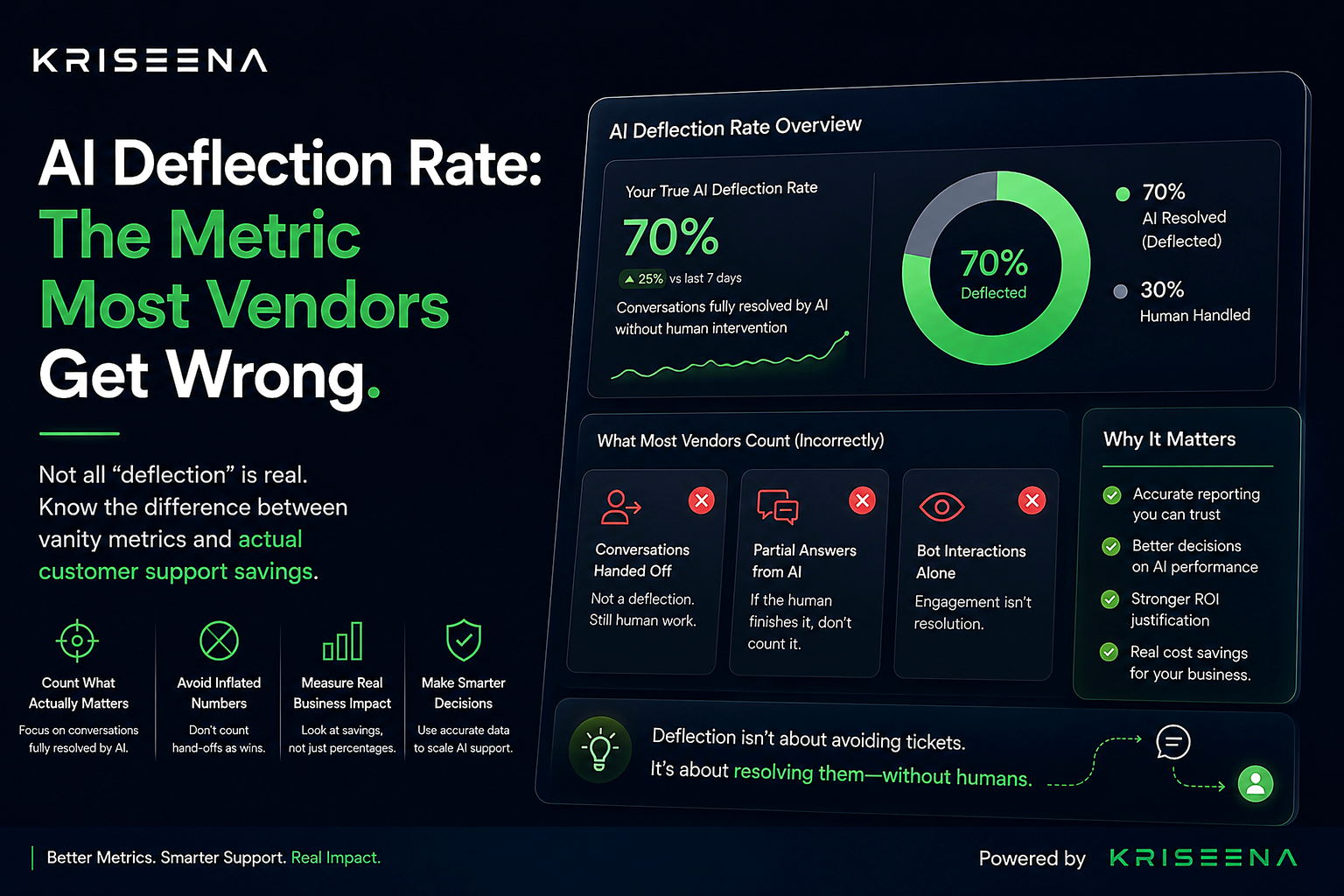
AI deflection rate is one of the most quoted metrics in customer support, and one of the easiest to manipulate.
If you're evaluating an AI support platform, expect vendors to advertise deflection rates of 80%, 90%, or even 95%. Those numbers sound impressive, but without understanding how they were calculated, they are almost meaningless.
A high deflection rate does not automatically mean customers received better support. In many cases, it simply means the vendor chose a generous definition of "deflected."
If you're responsible for justifying AI investment, you need a metric that stands up to scrutiny. This guide explains the correct formula, common tricks that inflate the number, realistic benchmarks, and why resolution rate usually tells a more honest story.
What is AI deflection rate?
AI deflection rate measures how many support requests were handled without requiring a human agent.
The important phrase is handled successfully.
A customer who leaves the chat after receiving a wrong answer is not a successful deflection.
Neither is someone who gives up because they cannot find the right help.
The purpose of AI-powered support is to solve customer problems, not simply reduce agent workload on paper.
The correct AI deflection rate formula
The formula should be straightforward.
AI Deflection Rate = (Successfully resolved conversations without human intervention ÷ Total AI conversations) × 100
The keyword is successfully.
Only conversations where the customer's issue was actually resolved should count.
Worked example
Suppose your AI handled 1,000 conversations during a week.
| Outcome | Conversations |
|---|---|
| Successfully resolved by AI | 620 |
| Escalated to human | 250 |
| Customer abandoned chat | 80 |
| AI gave incorrect answer | 50 |
| Total AI conversations | 1,000 |
Using the correct formula:
620 ÷ 1,000 × 100 = 62% AI deflection rate
Notice what is not included:
- Abandoned chats
- Incorrect AI answers
- Failed automation
Only successful outcomes count.
Three ways vendors inflate AI deflection rate
This is where numbers become misleading.
Many AI platforms publish impressive percentages by redefining what counts as success.
1. Counting abandoned chats as deflected
This is probably the most common trick.
Imagine a customer opens a chat, waits a minute, then closes the browser.
Some vendors classify this as:
"No human interaction required."
Technically true.
Operationally meaningless.
The customer never received help.
2. Counting FAQ page views
Another common tactic is combining chatbot interactions with documentation traffic.
For example:
- Customer reads a shipping FAQ
- Never contacts support
- Vendor counts this as AI deflection
A documentation page is valuable, but it is not evidence that an AI resolved a support request.
These should be reported separately.
3. Counting incorrect AI answers
Some vendors consider every AI response a successful interaction unless the customer explicitly requests an agent.
That creates obvious problems.
Imagine the AI confidently tells a customer that refunds take three days when the real policy says fourteen.
The customer leaves.
The vendor records:
Deflected.
Your support team receives the complaint two days later.
That is not successful automation.
Platforms that use confidence scoring avoid this problem by escalating uncertain conversations instead of guessing.
Why a 90% AI deflection rate is usually a red flag
At first glance, 90% sounds incredible.
In reality, it often indicates one of three things.
The AI answers when it should escalate
If the model almost never hands conversations to humans, it is probably answering questions beyond its confidence level.
That increases the risk of incorrect information.
Easy tickets dominate the data
Suppose 90% of conversations are simple order tracking requests.
High deflection is expected.
That says very little about the AI's ability to handle billing, returns, or technical issues.
The definition has been stretched
If abandoned chats, documentation views, and failed conversations all count as "deflected," almost any platform can advertise impressive numbers.
Healthy AI systems know when to stop.
Sometimes escalating to a human is the correct outcome, not a failure.
Deflection rate vs resolution rate vs containment rate
These metrics often get confused.
They measure different things.
| Metric | Measures | Best Use | Easy to Manipulate? |
|---|---|---|---|
| Deflection Rate | Conversations successfully handled without humans | Automation efficiency | Yes |
| Resolution Rate | Customer issues actually solved | Customer outcomes | Much harder |
| Containment Rate | Conversations that never leave the AI | Workflow analysis | Yes |
Resolution rate focuses on the customer's experience.
Containment rate focuses on process.
Deflection rate sits somewhere in the middle.
If you can only monitor one metric, resolution rate is usually the better business indicator.
Deflection rate vs resolution rate
Imagine two support platforms.
Platform A
- Deflection Rate: 91%
- Resolution Rate: 64%
Platform B
- Deflection Rate: 68%
- Resolution Rate: 82%
Which performs better?
Platform B.
It solves more customer problems even though fewer conversations stay inside automation.
Customers care about getting answers.
Executives care about lower costs.
Resolution rate helps both.
Realistic AI deflection rate benchmarks
Every ticket category has different automation potential.
Comparing them directly produces misleading expectations.
| Ticket Type | Realistic Deflection Rate |
|---|---|
| WISMO (Where is my order?) | 80% to 95% |
| Password resets | 75% to 90% |
| Store policies | 70% to 90% |
| Returns and exchanges | 50% to 75% |
| Billing questions | 45% to 70% |
| Technical troubleshooting | 20% to 50% |
For example, WISMO automation often achieves the highest automation because order tracking relies on structured data.
Technical troubleshooting rarely reaches those levels because each case contains more variables.
Context matters more than headline numbers.
Why ticket type matters
Imagine two companies.
Store A receives:
- 80% shipping questions
- 10% return requests
- 10% billing
Store B receives:
- 20% shipping
- 40% technical
- 40% product issues
Even with identical AI quality, Store A will report a much higher deflection rate.
Benchmarking without considering ticket mix leads to poor decisions.
How to measure ticket deflection correctly
If you want trustworthy reporting, follow a simple process.
- Count every AI conversation.
- Exclude abandoned chats.
- Exclude conversations with incorrect AI responses.
- Exclude conversations later reopened because the issue was unresolved.
- Count only successful AI-only resolutions.
This approach produces a lower number than many vendor dashboards.
It also produces a number you can defend during executive reviews.
Don't optimize for deflection alone
A support team chasing higher deflection rates can accidentally create worse customer experiences.
Examples include:
- Raising automation beyond safe limits.
- Delaying escalation.
- Hiding live agent options.
- Encouraging AI to guess instead of admitting uncertainty.
These practices improve dashboards while hurting customers.
Balanced measurement produces better long-term outcomes.
The role of confidence in honest automation
Good AI systems recognize uncertainty.
Instead of answering every question, they identify situations where human expertise is safer.
Confidence thresholds prevent risky automation by escalating conversations before incorrect information reaches customers.
That often lowers reported deflection rates.
It also improves trust.
Lower deflection with higher accuracy is usually a better outcome than aggressive automation.
Metrics that deserve more attention
Executives often ask for a single headline number.
Support leaders should provide a balanced scorecard instead.
Track AI deflection rate alongside:
- Resolution rate
- First contact resolution
- Human escalation rate
- Customer satisfaction
- Average handling time
- Repeat contact rate
These are support KPIs that actually matter because they reflect customer outcomes instead of dashboard optimization.
Questions to ask every AI vendor
Before accepting a reported deflection rate, ask:
- How do you define a successful deflection?
- Are abandoned chats included?
- Are incorrect AI responses counted as successful?
- How do reopened conversations affect the metric?
- Can I independently audit the calculation?
Clear answers usually indicate transparent reporting.
Vague answers often indicate inflated metrics.
Honest metrics build long-term trust
AI should reduce workload by solving customer problems, not by making dashboards look better.
An honest AI deflection rate acknowledges that some conversations should always reach a human. High-quality support is not about maximizing automation at all costs. It is about automating the right conversations while safely handing over the rest.
KRISEENA follows that principle by combining confidence-based automation with intelligent escalation, ensuring conversations that fall outside safe confidence levels are transferred instead of guessed.
If a platform advertises a 90% deflection rate, don't assume you've found the best product. Ask how the number was calculated first. The answer usually tells you more than the percentage itself.

Amrutha Suresh
Content Writer, Kriseena
Amrutha writes about AI customer support, e-commerce operations, and help desk best practices. She covers practical guides for support teams looking to scale without growing headcount.