
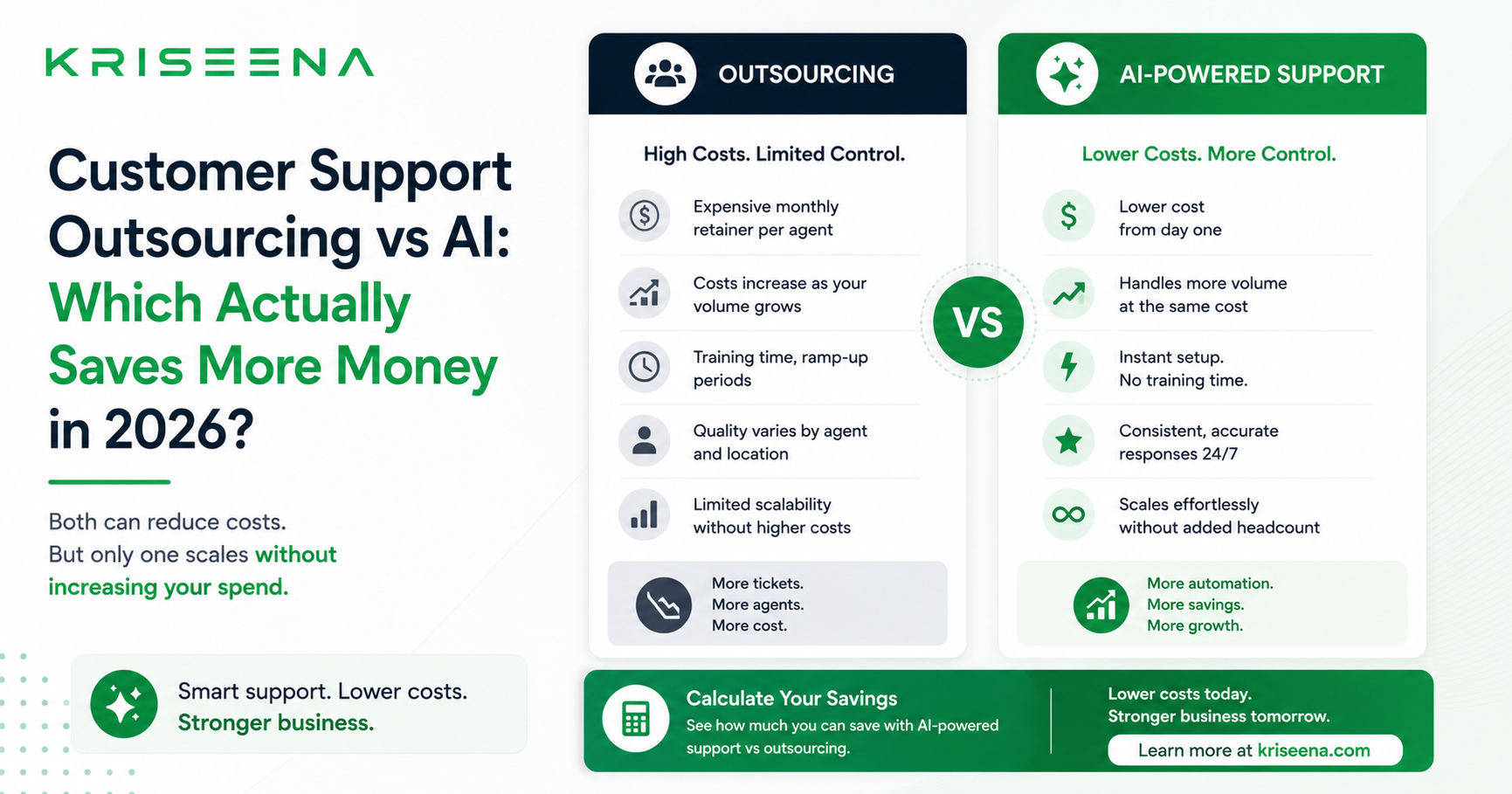
The Case for Outsourcing Customer Support
When support volume outpaces team capacity, outsourcing is the instinctive response. Hire a business process outsourcing (BPO) provider, hand over the inbox, and the problem is solved. The team stops drowning, the founder stops answering support emails at midnight, and the business can scale.
This logic is sound in principle. In practice, outsourcing customer support introduces a set of costs, quality risks, and operational dependencies that are rarely visible at the point of signing the contract — and that make it significantly less attractive than it appears.
This guide compares outsourcing against AI customer support on the dimensions that matter: total cost, quality, flexibility, setup time, and risk.
How Customer Support Outsourcing Works
Customer support outsourcing means contracting a third-party provider — typically a BPO (Business Process Outsourcing) company — to handle some or all of your support volume. The provider supplies agents, often based in lower-cost labour markets, who are trained on your product and processes and handle customer queries on your behalf.
Common outsourcing models:
| Model | How it works | Best for |
|---|---|---|
| Dedicated agents | A fixed team works exclusively on your account | Consistent high-volume brands |
| Shared agents | Agents handle multiple clients, billed per hour or ticket | Lower-volume businesses |
| Blended model | Dedicated agents for tier-1, overflow to shared pool | Seasonal businesses |
Providers typically operate from the Philippines, India, Eastern Europe, and Latin America, with pricing reflecting local labour rates. English-language support from the Philippines averages $8–$14/hour per agent; from Eastern Europe, $12–$18/hour.
The Real Cost of Outsourcing Customer Support
The headline rate from a BPO provider looks affordable. The total cost of outsourcing is rarely what the headline rate suggests.
Direct costs
Agent hours: At $10/hour and 8 hours/day, a single dedicated agent costs $80/day — $1,760/month — before any management overhead.
Minimum commitments: Most providers require minimum agent counts (typically 3–5 agents) and minimum contract terms (3–12 months). A business that only needs 1 agent's worth of work may pay for 3.
Training time: Every new agent requires onboarding — typically 2–4 weeks at reduced productivity. You pay for training hours. When agents turn over (BPO turnover rates average 30–45% annually), training costs recur.
Management overhead: Someone on your team must manage the outsourced team — briefing, quality checking, escalation handling, and process updates. This is not a zero-cost activity.
Hidden costs
Quality degradation over time: Outsourced agents handling multiple clients simultaneously have divided attention. CSAT scores for outsourced support average 5–15% lower than in-house teams on comparable query types.
Knowledge lag: When your product changes, policies update, or new issues emerge, the outsourced team is always one briefing cycle behind. In fast-moving businesses, this lag is felt by customers.
After-hours premium: 24/7 coverage requires night shift staffing, which most providers charge a premium for — typically 25–40% above standard rates.
Ramp time: From signing a contract to having trained agents handling live queries typically takes 4–8 weeks. Your overflow problem is not solved immediately.
Total realistic monthly cost for a 3-agent outsourced team:
| Cost component | Monthly estimate |
|---|---|
| 3 agents × $10/hr × 160 hrs | £3,840 |
| Management overhead (2 hrs/day internal) | £600 |
| Training and QA reviews | £300 |
| After-hours premium (if required) | £600 |
| Total | £5,340/month |
How AI Customer Support Works as an Alternative
AI customer support uses a large language model connected to your knowledge base and live store or product data to answer customer queries automatically. For queries below a confidence threshold, it drafts the reply for a human agent to review — meaning the human handles complex cases, not routine ones.
What AI handles automatically:
- Order status queries (WISMO) — reads live Shopify/WooCommerce data
- Returns and refund policy questions — from knowledge base
- Product questions — from knowledge base
- Account queries — from knowledge base
- Standard FAQ queries
What still needs a human:
- Emotionally charged complaints
- Complex multi-issue cases
- High-value customer escalations
- Chargebacks and disputes
For e-commerce businesses, AI typically handles 65–75% of support volume automatically. The remaining 25–35% requires a human — but that human is reviewing AI drafts rather than writing from scratch, which cuts their handle time by 60–70%.
Cost Comparison: Outsourcing vs AI
Assume a growing e-commerce brand handling 800 support queries per month:
Outsourcing scenario
| Detail | Monthly cost | |
|---|---|---|
| 2 outsourced agents (shared model) | $10/hr × 160 hrs × 2 | £2,560 |
| Internal management | 1 hr/day × £35/hr | £770 |
| Training and quality review | Ongoing | £250 |
| Total | £3,580/month |
AI scenario (e.g. Kriseena)
| Detail | Monthly cost | |
|---|---|---|
| AI platform | Flat monthly | £95/month |
| 1 internal agent (reviews drafts, handles complex) | 3 hrs/day × £20/hr | £1,320 |
| Total | £1,415/month |
Monthly saving with AI: £2,165. Annual saving: £25,980.
And this assumes the outsourced model is performing well — no turnover, no quality issues, no training delays.
Quality Comparison: What Customers Actually Experience
Cost is one dimension. Quality is the other — and this is where the outsourcing vs AI comparison becomes more nuanced.
Response speed
| Scenario | Outsourcing | AI |
|---|---|---|
| Business hours | 2–8 hours (email) | Under 15 seconds |
| After hours | 12–24 hours (unless premium) | Under 15 seconds |
| Peak volume (BFCM) | Degrades — same agent count | Unchanged |
AI wins on speed at every hour. No shift changes, no queue buildups, no degradation during volume spikes.
Consistency
Outsourced agents vary in performance. A business with 5 outsourced agents has 5 different interpretations of tone, policy, and escalation thresholds. Quality review catches the worst cases — it does not eliminate variation.
AI replies are consistent. Every WISMO query receives the same structure, the same accuracy standard, and the same tone — calibrated once and applied indefinitely.
Complex query handling
This is where outsourcing has a genuine advantage. A human agent can handle a nuanced multi-issue complaint, read between the lines of an upset customer's message, and make judgment calls that AI handles less reliably.
This advantage is real but narrow. Complex queries account for 25–35% of support volume. For the 65–75% that are routine, AI is faster, cheaper, and more consistent than outsourced agents.
When Outsourcing Is Still the Right Choice
AI is not the right answer for every business. Outsourcing remains appropriate when:
Your product is complex and queries require deep knowledge If most of your support queries involve multi-step technical troubleshooting, regulatory guidance, or product configurations that change frequently, outsourced specialists with deep training may outperform AI on resolution quality.
You need a human voice for brand reasons Some premium brands — particularly in luxury goods or high-touch services — maintain human-only support as a deliberate brand positioning. The personal touch is part of the product.
You are not ready to build a knowledge base AI is only as good as its knowledge base. If your policies and processes are not documented, AI cannot use them. Outsourced agents can be briefed verbally; AI requires written documentation. Teams that are too early or too disorganised to build a knowledge base are not ready for AI.
You need languages AI does not handle well AI handles English-language support very well. For non-English languages, quality varies. Outsourced multilingual agents remain stronger for languages outside the major European ones.
The Hybrid Model: Best of Both
Most businesses that adopt AI do not replace human support entirely — they restructure it. AI handles the volume; a smaller internal team handles the complexity.
Before AI:
- 3 outsourced agents handling 800 queries/month
- Cost: £3,580/month
- Average response time: 4–6 hours
After AI:
- AI handles 560 queries/month (70%) automatically
- 1 internal agent reviews AI drafts + handles 240 complex queries
- Cost: £1,415/month
- Average response time: under 15 seconds (AI), under 2 hours (human cases)
The hybrid model combines the speed and cost efficiency of AI with the judgment and empathy of a human for cases that warrant it. It is the configuration most businesses land on after 90 days of AI deployment.
Key Takeaways
- The real cost of outsourcing (including management overhead, training, turnover, and after-hours premium) typically reaches £3,500–£6,000/month for a 3-agent team — 3–4x the advertised rate
- AI handles 65–75% of support volume at a fraction of outsourcing cost, with faster response times at all hours
- Outsourcing retains advantages for complex query types, premium human-voice brands, and multilingual support beyond major European languages
- The hybrid model (AI for volume, 1 internal agent for complexity) delivers the best cost and quality outcome for most growing e-commerce and SaaS businesses
- Setup time: outsourcing takes 4–8 weeks to first live query; AI takes 3–5 hours
Frequently Asked Questions
Is it cheaper to outsource customer support or use AI? For most e-commerce and SaaS businesses handling 500–2,000 queries per month, AI is significantly cheaper than outsourcing. A realistic outsourced 3-agent team costs £3,500–£6,000/month including management overhead and training. An AI platform plus one internal agent reviewing complex cases typically costs £1,200–£1,800/month — a saving of £2,000–£4,000/month at comparable query volumes.
What are the disadvantages of outsourcing customer support? The main disadvantages are: higher total cost than the headline rate suggests (management overhead, training, turnover), quality variability between agents, knowledge lag when products or policies change, minimum agent commitments that may exceed actual need, and 4–8 week ramp time before agents handle live queries. CSAT scores for outsourced support average 5–15% lower than in-house teams on comparable query types.
Can AI fully replace outsourced customer support? For routine, factual queries — order status, policy questions, product FAQs — AI can fully replace outsourced agents. For complex, emotionally charged, or multi-issue queries, human judgment remains superior. Most businesses find AI handles 65–75% of their volume, with a smaller internal team handling the remainder. Full replacement of human support is appropriate only for businesses whose query mix is predominantly routine.
How long does it take to set up AI customer support? Setup takes 3–5 hours for most businesses: write knowledge base articles for your top 10 query types, connect your Shopify or WooCommerce store, configure the AI persona, and enable draft mode. Compared to the 4–8 week ramp time for outsourced agents, AI can be handling live queries within a single afternoon.
What is a BPO in customer support? BPO stands for Business Process Outsourcing — a third-party provider that handles business functions on behalf of a company. In customer support, BPO providers supply trained agents (typically based in lower-cost labour markets) who handle customer queries under the client's brand. Common BPO locations for English-language support include the Philippines, India, and Eastern Europe. BPO pricing is typically quoted per agent hour or per resolved ticket.

Aswathi
Content Writer, Kriseena
Aswathi specialises in SaaS product content and customer experience topics. Her writing helps e-commerce founders and support managers understand how AI fits into their existing workflows.