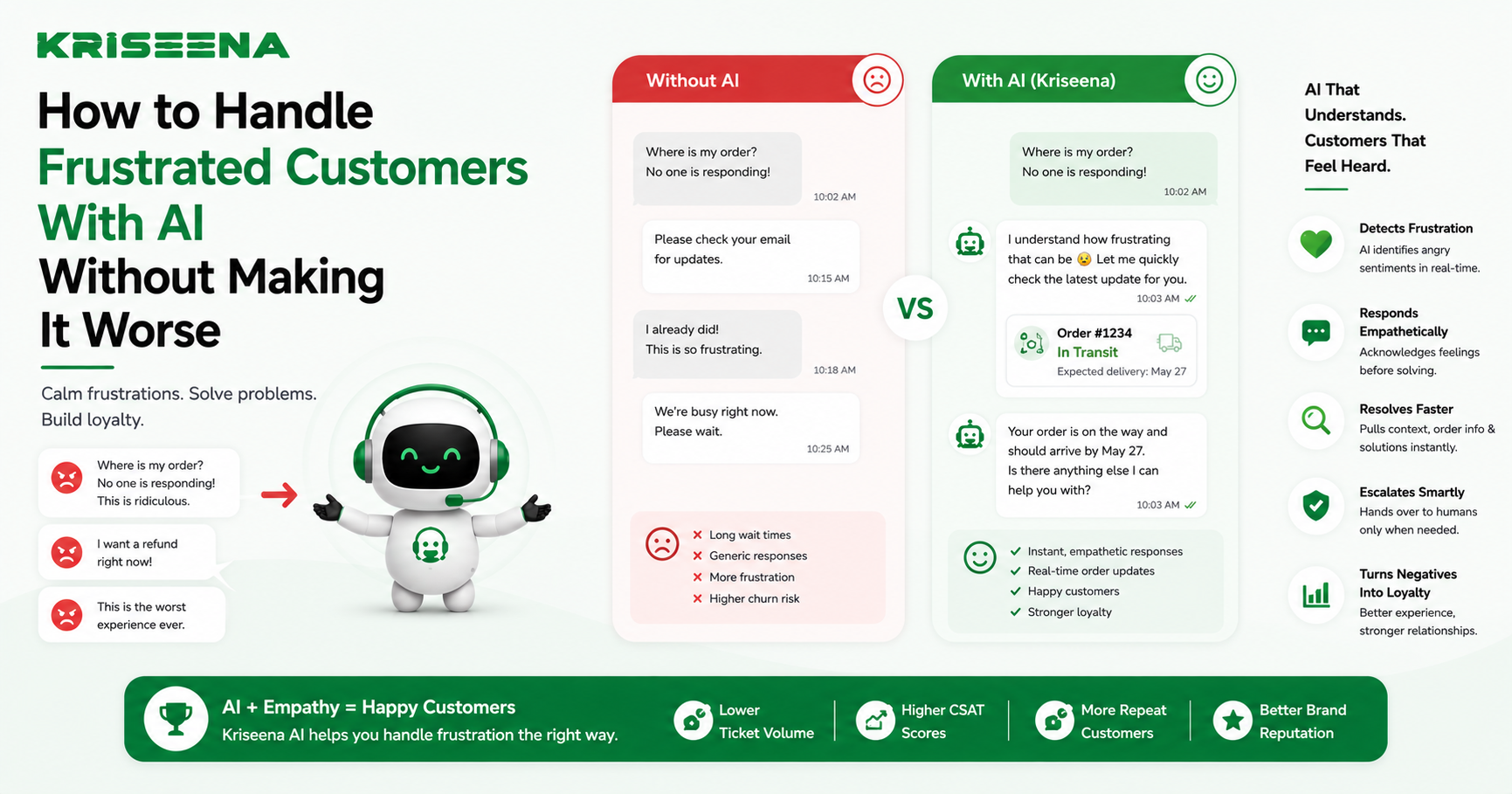
Every Frustrated Customer Is an Opportunity to Build Loyalty
Every eCommerce business eventually has to deal with frustrated customers.
A delayed shipment. A damaged product. A refund dispute. An order that never arrived.
These situations are inevitable. What determines whether a customer leaves a negative review—or becomes a loyal repeat buyer—is how your business responds.
Research consistently shows that customers are often willing to forgive mistakes when companies resolve them quickly and professionally. According to PwC's Future of Customer Experience report (2018), 73% of consumers say customer experience is an important factor in their purchasing decisions, behind only price and product quality.
Today's AI-powered customer support tools help businesses respond within seconds, automate repetitive questions, and give support teams more time to solve complex issues.
But automation alone isn't enough.
Customers don't want to feel like they're arguing with a chatbot. They want reassurance, accurate information, and confidence that someone is actively working to solve their problem.
The best AI doesn't replace empathy—it enhances it.
In this guide, you'll learn:
- Why frustrated customers require a different support strategy
- The most common reasons customers become upset
- How AI detects customer frustration
- Scripts for de-escalating difficult conversations
- When AI should hand conversations to a human
- Best practices for Shopify and eCommerce support teams
- How platforms like Kriseena combine automation with human support
Why Handling Frustrated Customers Requires a Different Approach
Most customer conversations are predictable.
Customers ask:
- Where is my order?
- When will my package arrive?
- How do I return an item?
- Is this product in stock?
AI handles these requests extremely well because they have clear answers.
Frustrated customers are different.
They're often looking for something beyond information.
They want:
- Reassurance
- Accountability
- Confidence
- Empathy
- Fast resolution
Giving the correct answer in the wrong tone can actually increase frustration.
For example:
Poor response
Your package is delayed due to courier issues. Please wait 3–5 business days.
Technically correct.
Emotionally ineffective.
A better response would be:
I'm sorry your order hasn't arrived as expected. I understand how frustrating delays can be. Let me check the latest tracking information and explain exactly what's happening.
Both responses provide the same information.
Only one makes the customer feel heard.
Why Customer Experience Matters More Than Ever
Customer expectations continue to increase every year.
Consumers now expect:
- Instant replies
- Proactive updates
- Personalized service
- Consistent communication across channels
According to Salesforce's State of the Connected Customer (2023), 88% of customers say the experience a company provides is as important as its products or services.
That means support is no longer just a cost center.
It's a competitive advantage.
Businesses that resolve issues quickly often retain customers who initially had negative experiences. Fast, empathetic support creates trust, encourages repeat purchases, and generates positive word-of-mouth recommendations.
The Most Common Causes of Customer Frustration
Understanding why customers become upset allows businesses to prevent many problems before they happen.
Shipping Delays
Nothing generates more support tickets than shipping uncertainty.
Customers commonly ask:
- Where is my order?
- Why hasn't tracking updated?
- It was supposed to arrive yesterday.
Many of these conversations can be avoided through proactive shipping notifications.
Stores using real-time order tracking reduce repetitive "Where Is My Order?" (WISMO) inquiries by giving customers self-service access to live tracking information.
Learn more about improving delivery transparency with Kriseena's Shopify Order Tracking:
https://www.kriseena.com/shopify-order-tracking
Wrong Orders
Receiving the wrong item creates immediate disappointment.
The customer may have purchased the product:
- For a birthday
- For a business event
- Before traveling
- As a gift
Support should prioritize solving the problem instead of explaining how the mistake happened.
Effective responses focus on:
- Replacement options
- Shipping timelines
- Refund choices
- Clear next steps
Customers care more about how quickly the problem is fixed than why it happened.
Damaged Products
Damaged deliveries create two immediate concerns:
- Will the company fix the issue?
- Can the business be trusted again?
The faster the business acknowledges responsibility and offers a clear replacement or refund process, the more likely it is to retain the customer.
Quick resolutions also reduce the chances of chargebacks, negative reviews, and public complaints.
Refund Disputes
Refund conversations are naturally emotional because money is involved.
Customers may feel:
- Ignored
- Treated unfairly
- Misled
- Uncertain about the process
AI should explain refund policies clearly while avoiding promises it cannot guarantee.
Whenever exceptions or policy disputes arise, the conversation should be escalated to a human agent.
Repeated Problems
Nothing frustrates customers more than repeating themselves.
If someone has already contacted support twice, asking them to explain everything again creates unnecessary friction.
Modern AI should preserve conversation history so customers never have to restart from scratch.
This is especially valuable for teams managing customer conversations through a shared inbox.
Kriseena's AI-powered customer support platform keeps conversations organized while providing AI-assisted responses and seamless collaboration between support agents.
Learn more:
https://www.kriseena.com/shopify-customer-support
Long Response Times
Waiting hours—or even days—for a reply is one of the fastest ways to lose customer trust.
According to HubSpot's State of Service Report (2024), customers increasingly expect immediate responses, particularly through live chat and messaging platforms.
AI dramatically reduces first-response times by answering routine questions instantly while allowing human agents to focus on more complex support requests.
Fast responses reassure customers that their issue is being addressed, even when a complete resolution takes longer.
How AI Detects Customer Frustration
Modern AI doesn't simply look for words like "angry" or "frustrated."
Instead, advanced customer support platforms analyze multiple signals throughout an entire conversation.
Common indicators include:
- Negative sentiment
- Repeated complaints
- Increasing message frequency
- ALL CAPS usage
- Multiple unanswered questions
- Requests to speak with a manager
- Mentions of refunds or chargebacks
- Threats to leave negative reviews
- Emotional wording such as:
- "Unacceptable"
- "Disappointed"
- "Ridiculous"
- "Cancel my order"
- "Never buying again"
Rather than relying on a single keyword, AI continuously evaluates the customer's emotional trajectory.
If frustration continues to increase, the system can automatically raise the conversation's priority, notify a support manager, or hand the conversation to a human agent before the situation escalates further.
Kriseena also uses AI Confidence Thresholds to determine when AI should answer independently and when it should transfer the conversation to a support agent instead of guessing.
Learn more:
https://www.kriseena.com/blog/ai-confidence-threshold
What AI Should Say to a Frustrated Customer
An effective AI response does more than answer a question—it helps calm the situation.
Every response should follow four simple principles:
1. Acknowledge the Customer's Frustration
People want to know they've been heard.
Instead of jumping directly into policies or tracking updates, acknowledge the problem first.
Good example
I'm sorry your order hasn't arrived yet. I understand how frustrating that can be. Let me check the latest update and see what we can do.
Simple acknowledgement immediately reduces tension.
2. Provide Clear, Specific Information
Generic responses create uncertainty.
Whenever possible, AI should provide:
- Current shipping status
- Refund progress
- Expected replacement timeline
- Return instructions
- Order-specific updates
The more specific the response, the more confidence customers have in the resolution.
3. Explain the Next Step
Customers should never wonder what happens next.
Every response should answer questions like:
- What happens now?
- Who is handling this?
- When should I expect another update?
- Do I need to do anything?
Clear expectations reduce unnecessary follow-up messages.
4. Maintain a Calm, Professional Tone
Even if a customer becomes emotional, AI should remain:
- Respectful
- Helpful
- Solution-focused
- Professional
Matching an angry tone only escalates the conversation.
AI De-escalation Scripts
Below are examples of AI responses that acknowledge the issue while moving the conversation toward a solution.
Delayed Order
Customer
My package still hasn't arrived. This is ridiculous.
AI
I'm sorry your order has been delayed. I understand how frustrating that is. I've checked your tracking information, and your shipment is currently with the courier. The latest estimated delivery is tomorrow. I'll continue monitoring the shipment, and if there's another delay, we'll help you explore the next available options.
Wrong Product
Customer
You sent me the wrong item.
AI
I'm sorry about the mix-up. That isn't the experience we want you to have. Please upload a photo of the item you received, and we'll arrange the fastest possible replacement or discuss refund options.
Damaged Product
Customer
My order arrived broken.
AI
I'm sorry your product arrived damaged. Please upload a few photos of the damage so we can verify the issue and arrange a replacement or refund as quickly as possible.
Refund Request
Customer
I still haven't received my refund.
AI
I understand you're waiting for your refund. I've checked your order, and your refund has already been processed. Depending on your payment provider, it may take 3–5 business days to appear in your account. I'll provide updates if anything changes.
Example of an AI-Drafted Reply
A strong AI response combines empathy with accurate information.
Customer
I've contacted support twice already. Nobody is helping me.
AI Draft
I'm sorry you've had to contact us multiple times. I understand how frustrating that must be. I've reviewed your previous conversations, so you won't need to repeat the details. Your replacement request is currently under review, and I've flagged this conversation as high priority. A support specialist will continue assisting you shortly.
Notice what the response avoids:
- It doesn't blame the customer.
- It doesn't repeat generic policy text.
- It doesn't make promises it can't verify.
- It explains exactly what happens next.
What AI Should Never Say
Poor responses often make situations worse.
Avoid responses like:
❌ "Please be patient."
❌ "Your request has been received."
❌ "As previously stated..."
❌ "According to company policy..."
❌ "We apologize for the inconvenience."
While technically correct, these phrases feel robotic when overused.
Instead, responses should sound conversational while remaining accurate.
When AI Should Hand the Conversation to a Human
AI is excellent for repetitive support requests, but some situations require human judgment.
A conversation should be escalated when:
- Customer frustration continues increasing
- Multiple AI responses fail to resolve the issue
- Refund exceptions require approval
- The customer requests a manager
- Legal or compliance concerns arise
- Payment disputes occur
- Account security is involved
- A VIP or high-value customer requires personalized attention
- The issue involves multiple departments
According to Microsoft's Global State of Customer Service Report (2023), many consumers still prefer speaking with a human when dealing with complex or emotionally charged issues.
Knowing when not to automate is just as important as knowing when to automate.
Combining AI With Human Support
The highest-performing support teams don't choose between AI and humans.
They use both.
A modern workflow typically looks like this:
- AI answers common questions instantly.
- AI retrieves live order information.
- AI monitors customer sentiment.
- AI drafts suggested replies.
- AI prioritizes urgent conversations.
- Human agents handle exceptions and sensitive cases.
This approach allows businesses to provide fast responses without sacrificing empathy.
For Shopify stores, combining AI with order-aware customer support can significantly reduce repetitive tickets while improving response consistency.
Read more:
Best Practices for Handling Frustrated Customers
Whether your support team consists of two people or two hundred, these practices consistently improve customer experience.
- Train AI using accurate product information and support documentation.
- Keep your knowledge base updated.
- Send proactive shipping notifications.
- Give AI access to live order information.
- Use sentiment analysis to identify high-risk conversations.
- Escalate emotionally complex issues quickly.
- Give human agents complete conversation history.
- Review AI conversations regularly to improve accuracy.
- Never let AI guess when confidence is low.
- Measure customer satisfaction after resolved conversations.
Businesses using AI responsibly improve both efficiency and customer satisfaction.
How Kriseena Helps Handle Frustrated Customers
Kriseena is built specifically for Shopify and eCommerce businesses that want faster customer support without losing the human touch.
Key capabilities include:
- AI-powered customer support
- Shared team inbox
- Live Shopify and WooCommerce order lookup
- Knowledge base integration
- AI confidence scoring
- Sentiment detection
- Slack notifications for high-priority conversations
- Human handoff when AI confidence is low
- Analytics and conversation insights
Instead of forcing customers through endless chatbot loops, Kriseena recognizes when a conversation needs personal attention and alerts your support team before the situation escalates.
Explore all features:
https://www.kriseena.com/features
Pricing:
https://www.kriseena.com/pricing
Frequently Asked Questions
Can AI really detect frustrated customers?
Yes. Modern AI uses sentiment analysis, conversation history, repeated complaints, urgency, and language patterns to estimate frustration levels rather than relying on individual keywords.
Should AI replace human customer support?
No. AI is most effective when handling repetitive questions while human agents manage emotionally sensitive or complex situations.
How can Shopify stores reduce customer frustration?
Providing real-time order tracking, proactive shipping updates, accurate AI responses, and fast escalation to human agents significantly improves customer satisfaction.
Why is sentiment detection important?
Sentiment detection helps identify conversations that are becoming increasingly negative, allowing support teams to intervene before customers leave negative reviews, request chargebacks, or abandon future purchases.
Final Thoughts
Every business will encounter frustrated customers. The difference between losing a customer and earning long-term loyalty often comes down to how quickly and effectively the issue is resolved.
AI makes customer support faster, more consistent, and available around the clock. But speed alone isn't enough. Customers also expect empathy, transparency, and confidence that someone is working toward a solution.
By combining intelligent automation, live order data, sentiment analysis, and timely human intervention, businesses can deliver exceptional customer experiences while reducing support workload.
For Shopify and WooCommerce stores, Kriseena brings these capabilities together in one platform—helping teams resolve issues faster, prioritize high-risk conversations, and provide support customers can trust.
Start your free 14-day Kriseena trial today: https://www.kriseena.com/signup