
One of the most expensive mistakes growing e-commerce businesses make is hiring support agents too early.
The second most expensive mistake?
Hiring them too late.
When ticket volume starts rising, founders and support managers often face the same question:
Do we need another support agent, or do we need better systems?
Unfortunately, most businesses answer that question based on gut feeling.
Support queues get longer.
Response times start slipping.
Customers become frustrated.
The instinctive response is to hire.
But adding headcount isn't always the right solution.
In many cases, stores can handle significantly more customer inquiries with better workflows, automation, and AI-powered support.
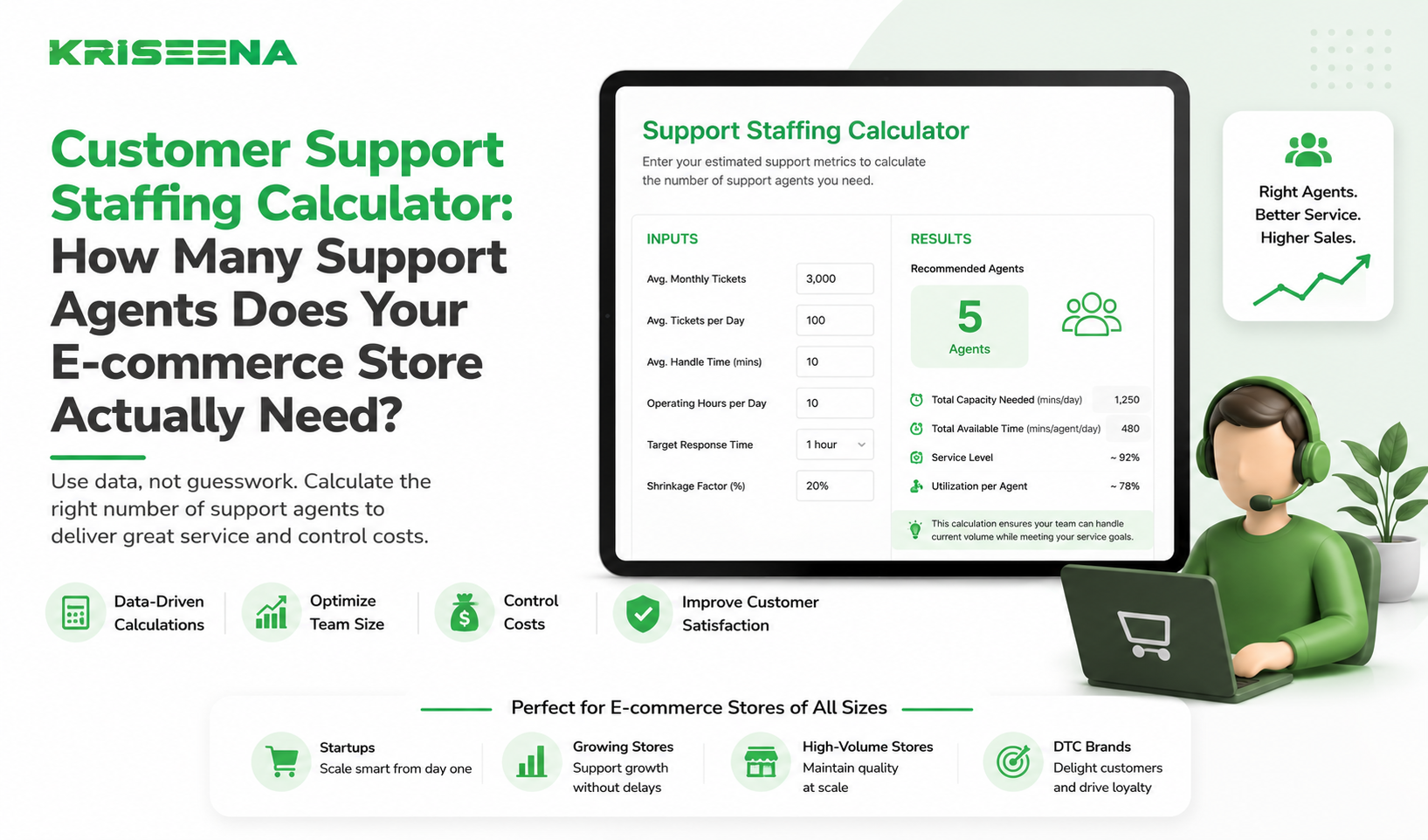
In this guide, you'll learn how to calculate support staffing requirements, forecast future needs, and determine when hiring is truly necessary.
Why Most E-commerce Stores Overhire Support Staff
Support demand grows naturally as stores scale.
More customers means:
- More orders
- More shipping questions
- More returns
- More exchanges
- More product inquiries
The assumption is straightforward:
More tickets = more agents.
But support volume and staffing requirements aren't perfectly linked.
For example:
Store A receives 1,000 monthly tickets.
Store B also receives 1,000 monthly tickets.
Yet Store A might need five agents while Store B only needs two.
Why?
Because staffing depends on more than ticket count.
Factors include:
- Ticket complexity
- Average handling time
- Automation levels
- Self-service adoption
- Order tracking tools
- Team efficiency
The goal isn't to hire based on volume alone.
It's to hire based on workload.
The Core Formula for Support Staffing
At its simplest, support staffing can be calculated using three inputs:
Monthly Ticket Volume
The total number of customer inquiries received each month.
For example:
- Email tickets
- Live chat conversations
- Social messages
- WhatsApp conversations
- Contact form submissions
Let's assume:
Monthly tickets: 3,000
Average Handling Time (AHT)
Average handling time includes:
- Reading the inquiry
- Investigating the issue
- Responding to the customer
- Completing any required actions
Example:
Average handling time = 8 minutes
Available Agent Hours
A full-time support agent does not spend 8 hours daily answering tickets.
Time is also spent on:
- Meetings
- Training
- Documentation
- Escalations
- Breaks
- Administrative tasks
A realistic support capacity estimate is:
120 productive support hours per month
per full-time agent.
The Formula
Total workload:
Monthly Tickets × Average Handling Time
Example:
3,000 × 8 minutes = 24,000 minutes
Convert to hours:
24,000 ÷ 60 = 400 hours
Required agents:
400 ÷ 120 = 3.33
Result:
You need approximately 4 support agents.
A Practical E-commerce Support Staffing Calculator
Use the table below to estimate staffing needs.
| Monthly Tickets | Avg Handle Time | Monthly Workload Hours | Estimated Agents |
|---|---|---|---|
| 500 | 5 min | 42 hrs | 1 |
| 1,000 | 5 min | 83 hrs | 1 |
| 2,000 | 5 min | 167 hrs | 2 |
| 3,000 | 8 min | 400 hrs | 4 |
| 5,000 | 8 min | 667 hrs | 6 |
| 10,000 | 8 min | 1,333 hrs | 12 |
This provides a starting point.
However, staffing decisions become much more accurate when additional variables are considered.
The Four Factors That Affect Support Capacity
Two stores with identical ticket volumes can have dramatically different staffing requirements.
Here are the biggest drivers.
1. Ticket Complexity
Not all tickets require the same effort.
Simple requests:
- Order tracking
- Shipping updates
- Return policy questions
may take less than two minutes.
Complex requests:
- Lost packages
- Refund disputes
- Subscription problems
- Multiple-order issues
can take twenty minutes or more.
Understanding your ticket mix is critical.
2. Channel Mix
Different channels require different staffing levels.
Email tends to be more efficient because agents can handle multiple conversations simultaneously.
Live chat and phone support demand immediate attention.
For example:
| Channel | Relative Staffing Need |
|---|---|
| Low | |
| Medium | |
| Social Messaging | Medium |
| Live Chat | High |
| Phone Support | Highest |
As real-time channels increase, staffing needs often rise.
3. Self-Service Effectiveness
A strong help center reduces support workload.
Customers who can quickly find answers don't create tickets.
Examples include:
- Shipping FAQs
- Return portals
- Order tracking pages
- Knowledge bases
The better your self-service experience, the fewer agents you'll need.
4. Automation Adoption
Automation changes staffing calculations dramatically.
Stores often discover that a large percentage of tickets involve repetitive questions.
Examples:
- Where is my order?
- When will it ship?
- Can I return this item?
- How long do refunds take?
These conversations are ideal for automation.
When You Actually Need Another Support Agent
Many businesses hire because support feels busy.
But busyness isn't always the best hiring signal.
Instead, monitor these indicators.
First Response Time Is Consistently Increasing
If response times continue rising despite process improvements, capacity may be reaching its limit.
Backlogs Grow Every Week
Occasional spikes are normal.
Persistent backlog growth is not.
When unresolved conversations accumulate week after week, staffing may need adjustment.
Overtime Becomes Routine
Short-term overtime can handle seasonal peaks.
Long-term overtime usually signals structural capacity issues.
Quality Scores Are Falling
As agents become overloaded, quality often declines.
Symptoms include:
- Shorter responses
- More mistakes
- Missed follow-ups
- Lower CSAT scores
Quality deterioration can indicate understaffing.
When You Don't Need Another Support Agent
Hiring isn't always the answer.
In fact, many support teams can increase capacity significantly without adding headcount.
You Have High WISMO Volume
"Where Is My Order?" requests often represent a large share of support volume.
If agents spend hours each day checking order status, automation may solve the problem faster than hiring.
Repetitive Questions Dominate Tickets
Look at your top ticket categories.
If most questions repeat frequently, automation may provide greater ROI than additional staff.
Your Knowledge Base Is Weak
Customers frequently create tickets because information is difficult to find.
Improving self-service can reduce demand before it reaches your team.
Agents Spend Time Switching Systems
Many support teams lose productivity because information lives in multiple platforms.
Reducing context switching can significantly increase capacity.
How AI Changes Support Staffing Economics
Historically, support scaled linearly.
Twice as many customers meant roughly twice as many agents.
AI changes that equation.
Modern AI support systems can automatically resolve many common inquiries.
Examples include:
- Order status updates
- Shipping questions
- Return policies
- Store policies
- Product FAQs
- Basic troubleshooting
This doesn't eliminate the need for agents.
Instead, it changes how agents spend their time.
Before AI
Agents handle:
- Simple questions
- Repetitive requests
- Complex problems
After AI
Agents focus on:
- Escalations
- Customer retention
- High-value interactions
- Complex issues
As a result, each support agent can typically manage significantly higher customer volumes.
Staffing Forecasting for Fast-Growing Stores
Support staffing shouldn't only reflect today's demand.
It should anticipate future growth.
A simple forecasting method:
Step 1: Calculate Ticket Growth Rate
Example:
| Month | Tickets |
|---|---|
| January | 2,000 |
| February | 2,300 |
| March | 2,650 |
Growth trend:
Approximately 15% monthly.
Step 2: Project Six Months Ahead
If growth continues:
2,650 × 1.15⁶
Projected volume:
Approximately 6,100 tickets.
Step 3: Estimate Future Staffing
At current productivity levels:
6,100 tickets
× 8 minutes
÷ 60
÷ 120
Result:
Around 7 support agents.
Forecasting prevents reactive hiring and gives teams time to prepare.
A Better Question Than "How Many Agents Do We Need?"
Most businesses ask:
How many support agents do we need?
A better question is:
How many tickets should require a support agent?
The answer changes everything.
Every ticket resolved through:
- Self-service
- Automation
- AI
- Order tracking tools
- Knowledge bases
reduces staffing pressure.
The most efficient support organizations don't simply hire faster.
They reduce the amount of work that reaches agents in the first place.
Conclusion
Support staffing is one of the largest operational expenses for growing e-commerce businesses.
Hiring too late hurts customer experience.
Hiring too early hurts profitability.
The right approach is to understand workload, capacity, and future demand before adding headcount.
By calculating ticket volume, handling time, and agent productivity, you can make staffing decisions based on data rather than intuition.
Just as importantly, you should evaluate whether support demand truly requires more people—or whether better systems can solve the problem.
For many Shopify and WooCommerce stores, automation and AI can handle a significant share of repetitive support conversations, allowing existing teams to support more customers without growing headcount at the same pace.
Kriseena helps e-commerce businesses scale customer support efficiently by answering customer questions using live order data and your knowledge base. Instead of hiring another agent to handle repetitive inquiries, automate them and let your team focus on the conversations that matter most.
Start your 14-day free trial today at https://kriseena.com.

Amrutha Suresh
Content Writer, Kriseena
Amrutha writes about AI customer support, e-commerce operations, and help desk best practices. She covers practical guides for support teams looking to scale without growing headcount.