
)
Choosing between Shopify and WooCommerce usually comes down to pricing, customization, and ease of use. But there's another factor that becomes increasingly important as your store grows: customer support.
The platform you choose affects how easily your support team can access order information, integrate with helpdesk software, automate workflows, and handle increasing ticket volumes.
The good news is that both Shopify and WooCommerce can power excellent customer support operations. However, they take different approaches that may suit different types of businesses.
This guide compares Shopify and WooCommerce specifically from a customer support perspective to help you make an informed decision.
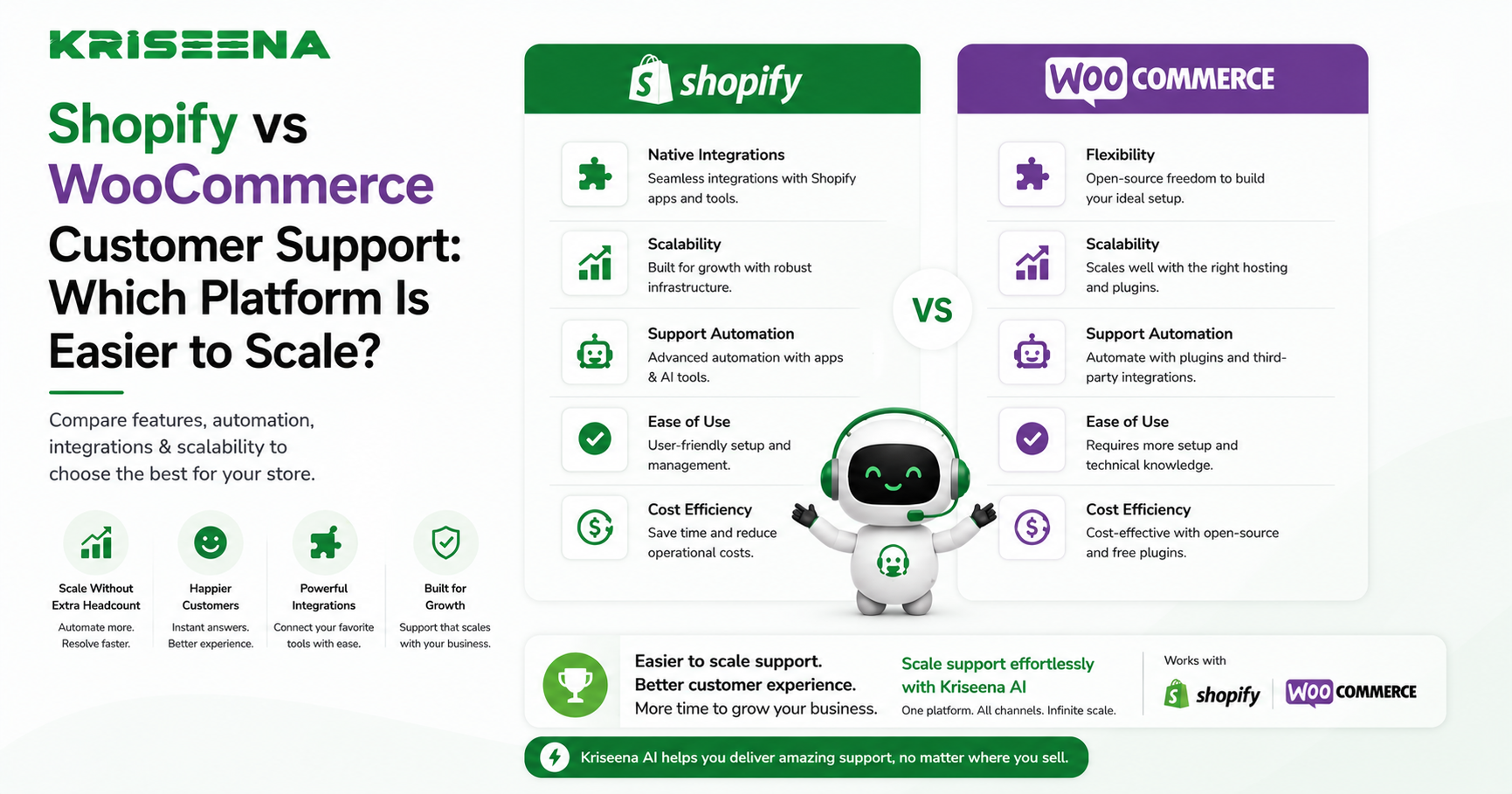
Quick Comparison
| Feature | Shopify | WooCommerce |
|---|---|---|
| Order data access | Built-in APIs with consistent structure | REST API plus direct database access |
| Helpdesk integrations | Extensive app ecosystem | Extensive plugin ecosystem |
| Customization | Moderate | Very high |
| Maintenance | Minimal | Store owner responsible |
| API reliability | Highly standardized | Depends on hosting and configuration |
| Best for | Fast-growing stores wanting simplicity | Businesses needing maximum flexibility |
Order Data Access
One of the most important aspects of customer support is quickly retrieving customer and order information.
When a shopper asks, "Where is my order?" or "Can I change my shipping address?", your support team should be able to answer without switching between multiple systems.
Shopify
Shopify provides a standardized platform with well-documented APIs that expose customer, order, fulfillment, product, and shipping information.
Because every Shopify store follows the same underlying architecture, helpdesk providers can build reliable integrations that work consistently across merchants.
Support agents can typically view:
- Order status
- Payment information
- Fulfillment progress
- Tracking numbers
- Customer details
- Previous purchases
- Refund history
Since the platform manages hosting and infrastructure, API performance is generally predictable.
WooCommerce
WooCommerce also provides comprehensive access to order and customer data through its REST API.
Unlike Shopify, WooCommerce runs on WordPress, giving store owners complete control over their environment.
This flexibility has advantages.
Developers can customize almost every aspect of order data, add custom fields, extend APIs, and integrate with virtually any business process.
The trade-off is that implementations can vary between stores.
Performance may depend on:
- Hosting quality
- Server configuration
- Plugin compatibility
- Database optimization
For well-maintained stores, these differences are usually minimal, but support software developers often need to account for greater variation than they do with Shopify.
Verdict: Shopify offers greater consistency, while WooCommerce provides greater flexibility.
API Availability for Helpdesks
Modern customer support relies heavily on APIs.
Helpdesk platforms use APIs to retrieve orders, display customer history, create notes, synchronize shipping updates, and automate workflows.
Shopify APIs
Shopify offers mature APIs that are widely supported throughout the e-commerce ecosystem.
Most major helpdesk platforms provide native Shopify integrations because:
- APIs are well documented.
- Authentication is standardized.
- Data structures remain consistent.
- Webhooks provide real-time updates.
This makes implementation relatively straightforward.
WooCommerce APIs
WooCommerce also offers a capable REST API that supports:
- Orders
- Customers
- Products
- Coupons
- Shipping
- Inventory
- Webhooks
Because WooCommerce is open source, developers can also extend or customize the API to support unique business requirements.
This level of control is particularly valuable for businesses with specialized workflows or custom-built extensions.
However, API performance and compatibility depend on how the store is maintained.
Verdict: Both platforms provide strong API support. Shopify emphasizes simplicity and consistency, while WooCommerce prioritizes extensibility.
Ticket Volume Differences
The platform itself doesn't directly determine how many customer support tickets you'll receive.
Instead, ticket volume is influenced by how the platform is configured and managed.
Shopify
Many Shopify stores experience fewer technical support requests because Shopify manages:
- Hosting
- Security
- Platform updates
- Core infrastructure
- Payment platform maintenance
As a result, customer inquiries often focus on:
- Order status
- Shipping
- Returns
- Refunds
- Product availability
- Account questions
Operational issues tend to be handled by Shopify behind the scenes, reducing the number of platform-related support tickets.
WooCommerce
WooCommerce gives merchants complete control, which also means greater responsibility.
In addition to standard order-related questions, support teams may occasionally encounter issues related to:
- Plugin conflicts
- Theme compatibility
- Checkout customizations
- Hosting performance
- Payment gateway configuration
- Custom functionality
Well-managed WooCommerce stores can provide an excellent customer experience, but stores with many third-party extensions may generate additional support requests when integrations conflict after updates.
It's important to note that these issues are not inherent flaws in WooCommerce. They are typically the result of customization choices or maintenance practices.
Verdict: Shopify often results in fewer infrastructure-related support tickets, while WooCommerce offers flexibility that may require more technical oversight.
Plugin and App Ecosystems for Customer Support
Customer support rarely depends on the e-commerce platform alone.
Businesses typically connect multiple tools for:
- Live chat
- Email support
- AI assistants
- CRM
- Returns management
- Reviews
- Automation
- Analytics
The availability and quality of integrations can significantly influence long-term efficiency.
Shopify App Ecosystem
Shopify's App Store includes thousands of applications covering nearly every aspect of customer support.
Popular categories include:
- Helpdesk software
- Live chat
- AI chatbots
- Returns management
- Customer feedback
- Loyalty programs
- Shipping notifications
- Self-service portals
Apps are generally easy to install and require little technical knowledge.
This simplicity makes Shopify especially attractive for merchants who want to deploy new tools quickly.
WooCommerce Plugin Ecosystem
WooCommerce benefits from the enormous WordPress ecosystem.
Merchants can choose from thousands of plugins, including many dedicated to customer support and automation.
Advantages include:
- Extensive customization
- Open-source flexibility
- Lower software costs in many cases
- Ability to modify plugin behavior
The downside is that merchants should pay closer attention to plugin compatibility, update schedules, and ongoing maintenance.
A carefully selected plugin stack usually performs well, but installing too many overlapping plugins can create unnecessary complexity.
Verdict: Shopify offers a more streamlined app experience, while WooCommerce provides unmatched flexibility through its plugin ecosystem.
Automation and AI Support
Regardless of platform, automation has become essential for modern customer support.
AI-powered tools can help teams:
- Answer repetitive questions
- Retrieve order information
- Suggest replies
- Route conversations
- Summarize customer interactions
- Reduce first response times
The effectiveness of these features depends more on the quality of the helpdesk than on the e-commerce platform itself.
As long as the helpdesk can securely access order data, AI can provide meaningful assistance to support agents.
Which Platform Is Easier for Support Teams?
The answer depends on your business priorities.
Shopify May Be the Better Choice If You Want:
- Faster setup
- Predictable integrations
- Minimal maintenance
- Consistent API behavior
- A managed infrastructure
It's an excellent option for businesses that want to focus on selling products rather than managing technology.
WooCommerce May Be the Better Choice If You Need:
- Complete ownership of your store
- Advanced customization
- Custom workflows
- Specialized integrations
- Greater flexibility over infrastructure
It's particularly well suited for businesses with unique operational requirements or in-house technical expertise.
What Matters More Than the Platform
While Shopify and WooCommerce have meaningful differences, the quality of your customer support depends more on your processes and tools than on the platform itself.
Successful support teams typically have:
- A centralized shared inbox
- Fast access to order information
- Automated ticket routing
- Internal collaboration tools
- AI-assisted responses
- Knowledge base integration
- Customer history in one place
These capabilities improve response times regardless of which e-commerce platform powers your store.
Using AI Helpdesks with Shopify and WooCommerce
Modern AI-powered helpdesks are designed to integrate directly with leading e-commerce platforms, allowing support agents to access customer and order information without leaving the conversation.
Kriseena works with both Shopify and WooCommerce, giving merchants access to AI-assisted customer support, order-aware conversations, shared inbox functionality, automation, and team collaboration from a single workspace.
This means businesses don't need to choose between Shopify and WooCommerce based solely on AI support capabilities. Both platforms can integrate effectively with modern support solutions when properly configured.
Final Thoughts
From a customer support perspective, neither Shopify nor WooCommerce is objectively better. They simply solve different problems.
Shopify delivers a polished, managed environment with standardized APIs, predictable integrations, and minimal maintenance. It's ideal for merchants who value simplicity and operational efficiency.
WooCommerce offers exceptional flexibility, deep customization, and complete control over your store. For businesses with specific technical requirements or custom workflows, that flexibility can be a major advantage.
Ultimately, the platform you choose should align with your business goals, technical resources, and long-term growth plans. With the right helpdesk and automation strategy, both Shopify and WooCommerce can support fast, efficient, and scalable customer service.
Whether your store runs on Shopify or WooCommerce, AI-powered platforms like Kriseena can help your team respond faster, automate repetitive work, and deliver a better customer experience without requiring a change to your existing e-commerce platform.

Amrutha Suresh
Content Writer, Kriseena
Amrutha writes about AI customer support, e-commerce operations, and help desk best practices. She covers practical guides for support teams looking to scale without growing headcount.